12 September 2012


18 August 2012
What's up

In her interviews she draws a distinction between the American and French traditions, "when an artist sees an object, he sees an object that is loaded symbolically but he also sees it visually" and says she employs "a mixture of this strong sentimental side and the visual side. In my work there are always these two elements, and I wonder if this is not opposed to minimalist American Art.. In Europe we have the weight of the past on us, which makes us much less direct than Americans who seem to always produce a kind of 'new art' without history." This opposition is historically denied, most famously in Adolph Gottlieb and Mark Rothko's 1943 New York Times letter "There is no such thing as good painting about nothing. We assert that the subject is crucial and only that subject-matter is valid which is tragic and timeless," but the subjects in late Rothkos and Gottliebs are to be sought, not "loaded" and apparent, perhaps less important to their imitators.
As in Europe, she finds in Mexican streets (which she visits often) "objects that are loaded symbolically" : "Visually it's just overwhelming; sometimes it's just too much, and you have to stop. The colors, the smells, the markets, everything. The religious iconography. There's this street in Mexico City, near the cathedral, and it's just filled with nothing but plaster religious icons!" the "forest of (Mexican) symbols" found in Alberto Gironella's assemblages (below). Her statement "I do see my work yes, as bric-a-brac, a surrealist hodgepodge.." suggests the visits to the flea market with Marcel Noll related by Andre Breton in Nadja and Gironella's methods.


Baudelaire in 1853: "The overriding desire of most children is to get at and see the soul of their toys, some at the end of a certain period of use, others straightaway.. The child, like the people besieging the Tuileries, makes a supreme effort, at last he opens it up, he is stronger. But where is the soul? This is the beginning of melancholy and gloom. There are others who immediately break the toy which has hardly been put in their hands, hardly examined;.. I do not understand the mysterious motive that causes their action."
de Chirico would disagree with Messager's view of the artists' "character." Messager: "Art is a secret shared between the individual and the collective. In order to be touched by a work of art, it must first refer to the person who made it, a strong personality, and it must touch the collective, everyone must find something in this order. Artaud is a good model for this. He made his drawings for himself only and we can all find ourselves in these portraits, his auto-portraits or his manifestos. It is precisely this back and forth between the individual, between the inside and the outside, the private and the public, which makes a work of art stand out, because it touches both worlds at the same time."
de Chirico: "Nietzsche very properly remarks: 'With the greatest respect one says of a man 'He is a character.' Yes - if he exhibits a course logic, a logic obvious to the eyes of the least discerning. But as soon as it is a question of a more subtle and profound spirit, which is coherent in its own way, the observer denies the existence of a character.' The same observation can be made on art, and also on painting. A profound picture will be entirely without the gesticulations, the idealism which attracts the attention of the crowd and makes the name of an artists well-known. All momentary posture, all forced movement will be put aside." (1911-15) Artaud invests his observations in his persona, but manages to evade the defects of the practice set forth by Nietzsche and de Chirico.
de Chirico became more attentive to form than content after his first solo show in Rome in 1919 came under critical attack and he became enamored of the Titians and Reubenses at the Villa Borghese. He soon thereafter designed stage sets with Diaghilev and others, an association which brought forth Picasso's Neo-Classical period (at his first wife's insistence), and so the Neo-Classical Cocteau came to de Chirico's defense when he began to fall out with the Surrealists. It could be that he reached a threshold in discerning content that he wanted the Rome critics and ballet culture to pull him away from. Neo Rauch appears to be undergoing a simlar process in the past few years, with less extensive development of enigmatic dramatic tableau and more references to art-historical approaches to form (below).

17 July 2012

As you may have guessed, the focus on labyrinths noted here (I, II) did come from Borges by way of Smithson, an avid reader of literature. Smithson in 1966: "Borges speaks of a labyrinth that is a straight line, invisible and unceasing" in proximity to his quotation of Pascal's he returned to two years later, "a looking-glass babel that is fabricated according to Pascal's remark, 'Nature is an infinite sphere, whose center is everywhere and whose circumference is nowhere.' Or (his italics) language becomes an infinite museum, whose center is everywhere and whose limits are nowhere." He also said in an interview that the artist shouldn't perceive art as unlimited but shouldn't know where the limits are. He noted Walter de Maria's lines in a landscape that went on for quite a while but stopped eventually, but these influences may help explain why 1970's Spiral Jetty is more visually labyrinthine than a straight line, but a line rather than an enclosure from an infinite circumference.
Although Smithson doesn't write specifically about Borges' conception of the labyrinth, its time-dimension according to Borges is well covered by Smithson. "The Garden of Forking Paths" was described by the Sinologist in Borges' story of the same name as "an incomplete, but not false, image of the universe as conceived by Ts'ui Pen. Unlike Newton and Schopenhauer, your ancestor did not believe in a uniform and absolute time; he believed in an infinite series of times, a growing, dizzying web of divergent, convergent, and parallel times. That fabric of times that approach one another, fork, are snipped off, or are simply unknown for centuries, contains all possibilities." Smithson noted the completeness of the visual form of the mandala amid what Ad Reinhardt inserts from his temporal experience and conception of history into his 1956 "Portend of the Artist as a Thung Mandala:"

"The rim of Reinhardt's Portend becomes an ill-defined set of schemes, entities half-abstract, half concrete, half impersonal fragments of time or de-spacialized oddities and monsters, a Renaissance dinosaurism hypostatized by a fictional ring of time - something half way between the real and the symbolic.
This part of the Portend is dominated by a humorous nostalgia for a past that never existed - past history becomes a comic hell. Atemporal monsters or teratoids are mixed in a precise, yet totally inorganic way. Reinhardt isn't doing what so many 'natural expessive' artists do - he doesn't pretend to be honest. History breaks down into fabulous lies, that reveal nothing but copies of copies. There is no order outside of the mandala itself.'" (Smithson 1968)
Commenting elsewhere on the representation of time and history, Smithson argued: "The sense of extreme past and future has its partial origin in the Museum of Natural History; there the 'cave man' and the 'space man' may be seen under one roof. It didn't occur to me then, that the 'meanings' in the Museum of Natural History avoided any references to the Renaissance, yet it does show 'art' from the Aztec and American Indian periods - are those periods any more or less 'natural' than the Renaissance? I think not - because there is nothing 'natural' about the Museum of Natural History. 'Nature' is simply another 18th and 19th C fiction." Smithson proposed "The Museum of the Void" modeled after Egyptian tombs and looking very much like the entrance to Ireland's Newgrange, (above) replete with spirals, which resounds with Simone Weil's "The future is the filler of void places" in Gravity and Grace, where she calls time "a substitute for eternity" and the past and future an "illusion" for "imaginary elevation," and "when pain and weariness reach the point of causing a sense of perpetuity to be born in the soul, through contemplating this perpetuity with acceptance and love, we are snatched away into eternity."

13 June 2012
What's up
Piri' Miri Muli' can confirm that Robert Morris' labyrinth will be at Sonnebend throughout the summer, irrespective of what else is showing there, and that any bird feathers found in it have not been placed there by humans.
Not to be outdone, Galerie Lelong has for the remainder of the week Hélio Oiticica's labyrinthine 1972 installation Penetrável Filtro, which seems to have predated by a year Morris' first labyrinth tho both are likely influenced by Robert Smithson's 1970 Spiral Jetty. Oiticica was at the time staying in the US, exiled from Brazil's suspension of habeas corpus: for a while in New York, later a guest of Roman Jakobson's at Cambridge, while his friend Haroldo de Campos was teaching in Buffalo. de Campos' poem Galaxias comes out of a speaker next to a speaker featuring Gertrude Stein's The Making of Americans, before Oiticica's posthumous instructions, displayed in the next gallery, stipulate that local TV and radio is on display further into the labyrinth along with a colorful complimentary punch. Lelong selected tasty orange juice after a careful review of the color scheme. Tropicália, a Penetrável shown in the Bronx Museum in 2006, was his first hit in Brazil, giving Gilberto Gil and Caetano Veloso the name for their music movement, but Oiticica didn't want his New York work to have quaint symbols of Brazil like Tropicália's live macaws.
The first body book of our era is Maurice Merleau-Ponty's Phenomenology of Perception; but this, with its humanist sense of the body as practice and project, is now distinctly passé. The shift from Merleau-Ponty to Foucault is one from the body as relation to the body as object. For Merleau-Ponty, the body is where something is being done; for the new somatics, the body is where something - gazing, imprinting, regimenting - is being done to you. It used to be called alienation, but that implies existence of an interiority to be alienated - a proposition of which somatic criticism is deeply skepticalMorris quotes Smithson: "the first bad body art was the Crucifixion."
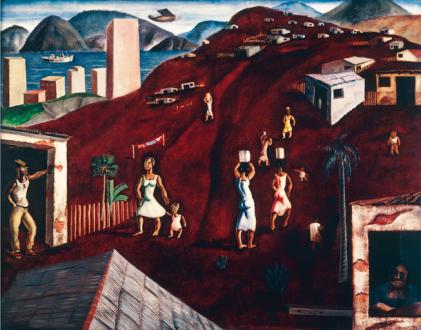 Oiticica's grandfather was the renowned Rio anarchist José Oiticica, his father an entomologist who dabbled in painting and photography and died in 1964, the year of Brazil's military coup. That year, Oiticica moved into Rio's rough Morro de Mangueira (right, Candido Portinari's 1933 "O Morro") making carnival costumes there (his "Parangoles") after an initially difficult initiation phase. Neo-Concretist sculptor Lygia Pape said "Helio was a young Apollonian, even a little pedantic, who worked with his father in the documentation of the National Museum, where he learned a methodology: it was very organized and disciplined. In 1964, his father died. A friend of ours took Helio to the Morro. It was there that he found a Dionysian space he had no knowledge or experience of... he began to incorporate the experience of the Morro.. the barriers of bourgeois culture broke there.. it's as if he were another Helio, Helio's a "Morro", which invaded everything: his home, his life and his work."
For those who didn't lose interest in easel painting by masters after the geometric decrees of the 1950s São Paolo Concretists' "10 Year Plan," especially painting with an "existence of an interiority to be alienated," get thee to the Carlyle, enter on the Madison side (no. 981 tween 76th and 77th), and make thy way up the steps to the right for a wonderful André Masson retrospective drawn from private collections, one of the best gallery shows up this decade, holding its own against John Richardson's latest Picasso show across the street with canvases of and by Françoise Gilot as well as Picasso's ceramics from Vallauris and some improvised sculptures, which if you check out (til June 30) don't forget to get off at the 3rd floor for Venus Over Manhattan's spooky JK Huysmans tribute (also til Jun 30) which includes a Gustave Moreau, Henry Fuseli's "Fairy Mab," Redon charcoals and graphites.

On the W side of 24th, Clemente packs as many inspired canvases as possible in Boone's space (til June 30) while many, many Lucio Fontanas are accommodated next door. South to Zwirner, Yan Pei-Ming more than pulls off his art history referentiality.
08 June 2012

02 June 2012
When I was 15 or 16 I took a class called Intro to Lyrical Poetry, which was to mean sung lyrics (rock/folk), in which we had to pick one song to bring in for the class and I picked this one. The lyrics were not on the album sleeve so I had to guess them and no one could decipher the last line: I substituted "a billion grains of sand with its hand in the ground fifty million years ago" for what this Youtuber decided was "and there were pendulums and sand and Coors cans in the ground fifty million years ago." The lyrics have to my knowledge never been officially published on the page.
24 May 2012
21 May 2012

Death is the resource of transfiguration. It is, of course, the way out of life as well as into life, and life, says the popular Mexican song, is worth nothing, no vale nada. But it is also the entry into life, since life is as valuable as our conscience decides it is.
-Carlos Fuentes Macías 1928 – 2012
07 May 2012
My impulse to cite Kafka in a discussion of political poetry may have come from a conference speech by Jean-Paul Sartre in 1963, when he said "Kafka wrote slim books which are only concerned with specific, petit bourgeois problems. But if one reads them in depth and discovers that totality which a modern, new novel must always aspire to attain. The totality is what the writers and readers have in common. Society produces both of us, so we must be able to recognize and understand each other through this common context, which makes it possible for us at every instant to speak to each other. So it does not matter very much if literature is called committed or not..."
In a similar vein, César Vallejo wrote in 1930 in his reflections on Mayakovsky that Bach, Beethoven, the Pyramids, Chaplin are "socialist" because "they answer to a universal concept of the masses and to feelings, ideas and interest common to.. all human beings without exception." Vallejo decried the emotional manipulation of Maxime Gorky's novels: "The socialist poet does not reduce his socialism to the themes or technique of the poem. He does not reduce it to the inserting of fashionable words on economy, dialectics or Marxist law, to mobilizing ideas and political requisitions from invoices or communist sources, nor to characterizing the actions of nature and the spirit with epithets taken from the proletarian revolution." It is at times a confused essay, especially as he was concurrently writing the socialist realist novel Tungsten, with clear demarcations of good and evil, which was the primary influence on José Maria Arguedas' first prose work Agua, which Arguedas said was "written with hatred, with the fury of a pure hatred, the kind that springs from universal loves up there in the regions of the world where two factions confront each other with inplacable cruelty - one group that bleeds and another that squeezes out the last drop of blood," the stark economic divisions of provincial South American towns affecting literary form, contrasted in Vallejo's mind with Mayakovsky's demise and European modernism.
Speaking of Arguedas, there is some footage of the Yawar (bloody) Fiestas from Cotabambas province, Peru: the tradition of tying a condor to the back of a bull on Independence Day to celebrate the joining of the Spanish and the Incan. The winged animal suggests a dragon figure joining earth and sky like the Mayan Q'uq'umatz, but for the Incans the sky was an empty space to be filled by Viracocha, whose top attendants assumed the forms of the cougar, condor, falcon and snake. This well edited 95 seconds is embed-disabled, but this has more footage of the type of bullfighting Arguedas depicted:
Here the condor rituals lead to it taking flight while a woman reads a poem:
In a similar vein, César Vallejo wrote in 1930 in his reflections on Mayakovsky that Bach, Beethoven, the Pyramids, Chaplin are "socialist" because "they answer to a universal concept of the masses and to feelings, ideas and interest common to.. all human beings without exception." Vallejo decried the emotional manipulation of Maxime Gorky's novels: "The socialist poet does not reduce his socialism to the themes or technique of the poem. He does not reduce it to the inserting of fashionable words on economy, dialectics or Marxist law, to mobilizing ideas and political requisitions from invoices or communist sources, nor to characterizing the actions of nature and the spirit with epithets taken from the proletarian revolution." It is at times a confused essay, especially as he was concurrently writing the socialist realist novel Tungsten, with clear demarcations of good and evil, which was the primary influence on José Maria Arguedas' first prose work Agua, which Arguedas said was "written with hatred, with the fury of a pure hatred, the kind that springs from universal loves up there in the regions of the world where two factions confront each other with inplacable cruelty - one group that bleeds and another that squeezes out the last drop of blood," the stark economic divisions of provincial South American towns affecting literary form, contrasted in Vallejo's mind with Mayakovsky's demise and European modernism.
Speaking of Arguedas, there is some footage of the Yawar (bloody) Fiestas from Cotabambas province, Peru: the tradition of tying a condor to the back of a bull on Independence Day to celebrate the joining of the Spanish and the Incan. The winged animal suggests a dragon figure joining earth and sky like the Mayan Q'uq'umatz, but for the Incans the sky was an empty space to be filled by Viracocha, whose top attendants assumed the forms of the cougar, condor, falcon and snake. This well edited 95 seconds is embed-disabled, but this has more footage of the type of bullfighting Arguedas depicted:
Here the condor rituals lead to it taking flight while a woman reads a poem:
27 April 2012
21 April 2012
What's up for two more days, v.5, I mean one day

Ending today is the New York debut of Punjabi artist Visha Gahotra (513 w 20th St), which welcomes guests with her 2008 installation "Neo-camouflage" (above): six soldier mannequins matching the color pattern of an Indian megalopolis' urban labyrinth, which resonates with the imagery of another show ending today: Robert Morris' "Labyrinths" at Sonnabend (536 w 22nd St). Morris got his start as an artist at age eight, taking the bus to the Nelson Atkins in Kansas City and laying out with his crayons in front of the Egyptian reliefs, later pastiching their Cezanne and, as in this show, Goya's "Caprices," among his many art history references to come. He is heavily influenced by some linguistic theorists: Wittgenstein, Chomsky, Davidson.

Morris' show presents his labyrinth drawings throughout his career and a wire fence labyrinth in the back courtyard. My experience of walking through the labyrinth was moving and personal, not tied to one image or specific issue. I didn't think for a second about prison camps, though Morris had used the wire fence two years ago for a labyrinth in Łódź, Poland, 30 miles from the Chelmno concentration camp where the Nazis enclosed a wire fence inside another, and indeed the Łódź ghetto had a labyrinthine grid. Wire fences also form a labyrinth at the Guantanamo detention camp. Morris' labyrinths are very straightforward as mazes, not usually giving you much opportunity to get lost. He uses many variations of scale, altering the participant's type of reflection, which he doesn't discuss much though he notes in an essay the monumental size of Nazi architecture. I found the wire fence very utilitarian - in a good, practical way - "here's your labyrinth" - and the transparency of the fence affected my experience, allowing me to know that I was there in a labyrinth and gaze out at the world beyond it.


The labyrinth has been called an "incomplete" mandala: it would seem that the labyrinth locates, like the mosaic at Chartres, the pilgrim more at a moment in time and space but Japanese mandalas are situated in specific places. The axe (labrys) appears in both, in the labyrinth to slay the bull and in one of the many hands of Vajrabhairava in mandalas, who like the Minotaur often has a bull's head, and whose use of the axe eventually abolishes duality. The labyrinthine floor mosaics in ancient Greece were used for dances.

The "star shaped dodecagon behind trenches" which the architecture scholar Austerlitz in WG Sebald's novel of the same name says was the preferred design for fortified cities by the end of the 17th Century, which the narrarator says "strikes the layman as an emblem.. of absolute power" reminds me of a Carl Gustav Jung mandala (left). The early Sumerian towns seem to have consisted of a temple surrounded by labyrinthine streets, which, like the medinas of North Africa, gave locals an advantage over invaders. Walter Benjamin's Arcade Project was by his account inspired by Louis Aragon's sections in 1926's Le Paysan de Paris of the destruction of labyrinthine streets when (as with Gahotra's cityscape) they suddenly were considered an obstacle to social control. Morris sees in the labyrinth a mythology preceding its physical remains which evades logic and experience, quoting from Wittgenstein's Philosophical Investigations 203: "Language is a labyrinth of paths. You approach from one side and know your way about; you approach the same place from another side and no longer know your way about." Aragon started his novel out with an attack on philosophers, "incapable of tackling the smallest problem without first going through the routine of recapitulating and then refuting everything that predecessors have had to say" and then proposes that the labyrinthine passages around the Opera quarter "are not yet inhabited by a deity. It is forming there, a new godhead precipitating in these recreations of Ephesus like acid-gnawing metal in the bottom of a glass."

Subscribe to:
Comments (Atom)