31 May 2015

What's up

The 118 e 64th St Boesky gallery fills three creaky, atmospheric floors of vintage trim carpentry with later works by Dorothea Tanning, mostly after the death of Max Ernst, a phase of looser brush strokes (as below), an increasing O'Keefe influence from her time in Sonora with Ernst, Matta too, and, in one canvas, an upside-down head resembling Bacon's in 1944's Three Studies for Figures at the Base of a Crucifixion. The Yale Review's J.D. McClatchy gave Tanning a copy of his American poetry anthology (displayed) in which she underlined passages, saying nice things about Charles Wright* and Louise Glück and not so nice things about Carolyn Kizer, and later produced a monograph** in cooperation with McClatchy and his friend James Merrill. This is the basis for interspersing her works with "examples of poems that were especially meaningful to the artist," as well as readings of poetry from the anthology coming from a speaker in the ground floor, completely devoid of her own poems or any Surrealist poems, including poems by Adrienne Rich and Rosanna Warren based on her works that aren't very good, but meeting the approval of Tanning. None of her own poetry is on the walls either, despite Greywolf Press recently publishing her verses. Amid all these associations and influences there is a uniquely personal, allegorical development in this period of her work and this is a show not to be missed.


A few blocks up at 32 East 69th Street is another spacious show of late works til June 20, these by Leon Golub, including early large scale war paintings in the first two floors, mostly unspecific but one from 1969 from his Napalm series.  The third floor features personal un-subtle works about death: two large scale acrylics, one called "Time's Up" and another with notes from the Egyptian Book of the Dead on it, adjacent to a gallery of cartoonish oil stick on bristols 8"x10" or less, sticking to the death theme.

Dominique Lévy offers til June 13 three dozen Calder sculptures in an enjoyable white room designed by Santiago Calatrava which requires you to cover your shoes, if you can't wait for his four billion dollar PATH station. Downstairs are collages of Korean mulberry bark paper by Park Seo-Bo at Galerie Perrotin, whose previous show was an installation by Elmgreen and Dragset that brought us the press release (pdf): "'Past Tomorrow'.. follows the life of.. an elderly, disillusioned and failed architect, after his inheritance runs out and he is forced to leave his home in London's South Kensington neighborhood, resettling in a smaller apartment in New York's Upper East Side. . An old man whose lifestyle and beliefs are grounded in the past and no longer align with contemporary culture, Swann's character can be regarded as a metaphor for 'old Europe', stubbornly refusing to face its changed position within the world," an indication that Donald Rumsfeld is eclipsing Ruskin as an influence on Upper East Side curators.  Their installation included a full length play in text form, in which the architect shows an exuberant enthusiasm for Foucault, pictured with Deleuze (right) on one of numerous glossies on the wall, not combined with any substantive discussion of any of his texts, leading to sit com-ish family interventions, with no indication that either the playwrights nor the curators understand a single point Foucault ever made.

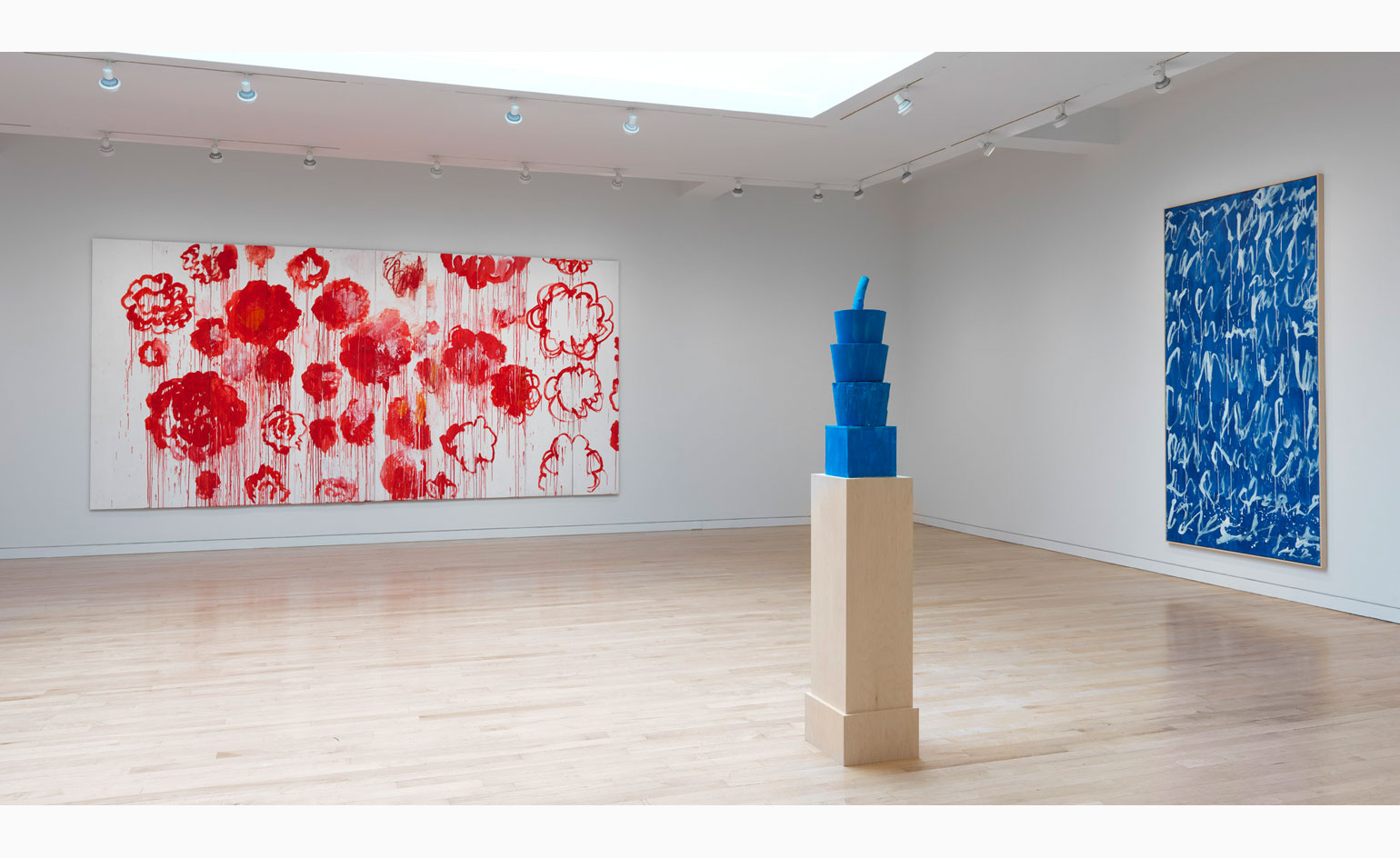
Twombly's late paintings at Gagosian 980 Madison til June 20 are pared down on account of his physical decline, featuring the red-on-white, "funereal" "Blooming" from his "Scattering of Blossoms" series which was all the more powerful for me perhaps since I hadn't seen the more extensive 2007 show, with its press release stressing a connection to Bashō and Japanese hokku, of which this translation comes to mind:

an octopus pot -
inside, a short-lived dream
under the summer moon

Several Twombly sculptures are also featured.  In the same building is a show of Miró's Birds in Space til June 13 and works that "chronicle the cowboy’s rise to omnipresence in art" til July 11.  Across the street at 975 Madison, Burri Fontana Manzoni & Tàpies til June 6. Michael Werner has Sigmar Polke's white on white, mostly abstract Silver Paintings til June 27, made of 'silver bromide, silver sulfate and silver nitrate,' arising from his interest in alchemy.

Organized by Televisa, the people who brought you the Enrique Peña Nieto serial, is a retrospective of the cinematography and early photographs of Gabriel Figueroa at Museo del Barrio til June 27, who shot much of the Golden Age of Mexican cinema as well as Buñuel's Los Olvidados, The Young One, Nazarín, The Exterminating Angel, and Simon of the Desert plus John Huston's The Night of the Iguana and Under the Volcano (all Piri' Miri Muli' recommended).  Themes of Figueroa's shots are compared to the paintings of Mexican contemporaries, beginning with several landscapes by Dr. Atl and including Rivera, Orozco, and a Buñuel collage co-created by Alberto Gironella (not the one to the right, another one); a gallery of photos including Manuel Álvarez Bravo and two by Juan Rulfo, leading to a room for screening clips from his Mexican oeuvre.  It is well presented, taking up the entire exhibition space, with a dramatic 'video art'-style montage at the entrance, and tho some protest "the absence of specialized full-length screenings," Film Forum has you covered, devoting two weeks of repertory to highlights from his career June 5-18.

Delhi Art Gallery in Midtown has a show of modern Indian art til June 6, to go with the Queens Museum's Indian Modernism to Contemporary India, 1947/1997 til June 28, to save you the 20 hour flight to the National Gallery of Modern Art in Delhi - I'll try to get to both this week.

As with Twombly, Gagosian's Chelsea show of Michael Heizer (til July 2, 24th St) contains signature works familiar to those who have followed his career and is selling quite well.  It is a massive, monumental show if you're in the neighborhood. I was kinda hoping that declaring his "City" in Nevada a Basin and Range National Monument would be, as alleged by a Republican congressman, "affecting aircraft sorties from the Nevada Test and Training Range" but Harry Reid staffers have shot that possibility down in a manner of speaking.

If you're tired and you want to lie down and indulge any nostalgia for late 60's MIT computer graphics, head for Stan VanDerBeek's Poemfield series at 544 w. 24th St. Andrea Rosen also has quite a wonderful selection of Motherwell's "Opens" series at 525 24th, both til June 20.
* I had a phase in high school where I liked some of Charles Wright
** as with the subtitles for Olivier Assayas' Something in the Air there's a reference to a poet named John Ashberry.. wasn't that an Otter Pop?

25 May 2015

What's up for another week, v. VII

Speaking of CoBrA, the Western Hemisphere's largest collection of the group's works is actually at the NSU Art Museum in Fort Lauderdale, but unfortunately they don't show it.  A large section of the museum is dedicated to the paintings of William Glackens, space that could be divided up, and a vast majority of the space is for temporary exhibtions of artists that are fashionable elsewhere, despite a large number of vacationing visitors and part time residents

The museum's Kahlo/ Rivera show is still up til the 31st, showing the Gelman collection of Kahlos and Riveras, which I recall seeing in NYC a few years back but I can't recall where but here with several Kahlo drawings I hadn't seen before, I think second only to the Dolores Olmedo collection of those two artists.  Added to that is the Goodman collection of Mexican paintings including early Tamayos and Toledos, in fact a masterwork from a teen Toledo with two others, the first Mexican painting by Leonora Carrington (below), Remedios Varo's Minotaur (left), several Gerzsos.


Update 5/26: Just heard from the nice folks at NSU that a new exhibition up til October features Asger Jorn and others from that collection, so Piri' Miri Muli' readers can see 'em both this week, and it hasn't hit 90 degrees yet.  Still a permanent display would be more visible when guests like me are there at other times.

24 May 2015

What's up for one more, well, a few hours..

The Wifredo Lam: Imagining New Worlds retrospective, the product of ten years of work by Boston College's Elizabeth Goizueta, is winding up in Atlanta, and as with her other research interest, Matta, I have difficulty summarizing my thoughts in advance of its closing. There are a few original thoughts I can quickly relate while other questions will pop around in perpetuity..

Lam is commonly named as one of the rare students of Picasso. Lam, Gilot, and...? Breton wrote "Picasso has chosen to show a greater interest in Wifredo Lam than any of the younger painters." The show includes original Lam illustrations (left) for Fata Morgana.

Why didn't Picasso take on students? 1960: "To know what we are doing cubism we should have to be acquainted with it! Actually, nobody knew what it was. And if we had known, everyone would have known... The condition of discovery is outside ourselves, but the terrifying thing is that despite all this, we can only find what we know." Two statements to Jaime Sabartes: "If you want to draw a circle and be original, don't try to give it a strange form which isn't exactly the form of circle. Try to make the circle as best you can. And since nobody has made a perfect circle, you can be sure that your circle will be completely your own. Only then will you have a chance to be original." "In the museums, for example, there are only pictures that have failed.. Those which today we consider 'masterpieces' are those which departed most from the rules laid down by the masters of the period. The best works are those which most clearly show the 'stigma' of the artist who painted them."


Why did the take on Lam? I quoted here a few years back the recently departed Galeano's quip "Pillaged by its colonial masters, Africa would never know how responsible it was for the most astonishing achievements in twentieth century European painting and sculpture" but Picasso, a political anti-imperialist, immediately and paternalistically sought to get Michael Leiris, studying African art intensively, to tutor the quarter African, half Chinese Lam on the subject, which Lam knew about but he wanted to know more and revered Picasso, Breton's explanation for the apprenticeship. Picasso's influence was crucial to Lam, crucial to Picasso, to the future of Caribbean art, the CoBrA movement, so on and so forth, and Picasso seemed to have little doubts or reserve about the opportunity. Lam reflected "I could act as a Trojan horse that would spew forth hallucinating figures with the power to surprise, to disturb the dreams of the exploiters."


Lowery Sims wrote "(Lam) decided not to follow the wishes of his godmother, Mantonica Wilson, a Santeria religious leader, that he become a babalao (high priest)." Richardson said Picasso's mother "although incapable of understanding his son's work.. always had implicit faith in his messianic aspirations." The subconscious desire to realize these lofty aspirations through unconventional means, I think, bound them. Also several years before he met Lam, Picasso completed his etching Minotauromachia, which I thought "appears to depict Marie-Thérèse Walter as a wounded, skeletal torera attached to a horse and also the bearer of the light that the bull hurls itself at. Juan Larrea remembered "hearing from (Picasso's) own lips as an obiter dictum that in pictures from a certain period of his artistic development, the horse generally represents a woman who played an exceptionally important part in his life." Sims wrote "Lam's 'horse-woman'.. personifies the devotee who is literally 'ridden' by the possessing orisha in the Santeria toque (drum rhythm)." Lam also spent his adolescence in the Prado, which may explain why it looks as if the figures in Bosch's Garden of Earthly Delights are often arraigned in the manner of Las Meninas.

I loathed the High Museum building before it was renovated and, after its expansion, my loathing of it has expanded, as it is an extended joke directed at anyone who arrives with a mind to look at the art rather than regard the visit as conspicuous consumerism in a floor plan that prevents walking from one side of the building to the other, confining visitors to one area. Aside from a large section of outsider art, acquisitions have from the beginning have been minor, decorative afterthoughts, eager not to offend traditional sensibilities especially in its earlier acquisitions.

23 May 2015

Some commentary on today's beatification of Archbishop Romero over at WKMA..

17 May 2015

Actually I was offline for two weeks and when I got my account set up the other day I was happy, not because I was online again so much as I had the pleasure of being offline for two weeks.
The Apu Trilogy comprises Piri' Miri Muli's best ever adapted screenplay,* best film about being a writer,** and perhaps the best romance (for the last episode). I have vhs copies of it somewhere but it hasn't been on dvd for a while. This predicament has come to a happy end, as the Criterion restoration made from four different sources and a negative that was burned in the 1990s is out, and I got to Film Forum this week to see Aparajito (The Unvanquished). My favorite has always been no. 3, The World of Apu, but watching Subrata Mitra's tracking shots of Varanasi projected helped me get into the sad beauty of no. 2. They had a little bit of a budget after making the first on a shoestring and put it on to the screen. There are crowd scenes of the ghats but no crowd scenes in Calcutta - the Calcutta sequences happen in studios, with two scenes on architecturally interesting street corners and one scene loafing on a big lawn in front of what appears to be Victoria Memorial.


Of the novels, the childhood memoir Pather Panchali was the biggest hit in Bengal, and Ray filmed it with borrowed money on Sundays between his advertising gig not knowing he would make a sequel. Translator T.W. Clark doesn't believe an English word exists for panchali: "These poems (panchali) were transmitted from generation to generation by strangers who chanted them with musical accompaniment at the appropriate ceremonies, which often lasted for ten days or more, or by actors who produced them in popular form on the stage of the indigenous theatre. The heroes, and the episodes in which they figure, were part and parcel of the Bengali cultural inheritance, and still are." Apu's initiation in the Trilogy follows novelist Bebhutibhushan Bandopadhyay's own life very closely, a sort of diary imagined as an oral epic eventually to become the main inspriration for Akira Kurasawa's reflection "Never having seen a Satyajit Ray film is like never having seen the sun or moon." They'll be showing in rotation there for the rest of the month and are to make their way to Philly soon and then to dvd land.

* The four films on my top 15 list that would be considered for this would be Stalker, Apu, and A Passage to India. I vouch for the last as an adaptation but Lean probably wouldn't even compare it to Apu. Stalker, like Solaris, was Tarkovsky's literary reworking of a sci fi concept;
** Followed closely by La Notte by Antonioni who said "My admiration for Ray is total" with Ray's 1964 The Lonely Wife, one of many of his films in need of restoration, not far behind. 

Update 5-31: Film forum is holding over the Trilogy til June 16 and they are in rotation in Philly's Ritz at the Bourse now.

19 April 2015

What's up for six more days, v. XVI

Brian Maguire, Erika
Seeing Brian Maguire's painterly dispatches from Cuidad Juárez in person (514 w26th St, til April 25) not only allows one to take in the large scale paintings but throws in a screening of the 80-minute documentary Blood Rising, co-produced by and featuring Maguire (pdf). Blood Rising is a good name for the overall mood of the paintings, as they are angry, strident, and unambiguous, depicting the unrelenting violence afflicting the corrupt, gang-infested border city. Attention was first paid in the English language press to the 'feminocidio' of Juárez when Charles Bowden published an account of the post-NAFTA urban landscape in the December, 1996 issue of Harper's (pdf) in cooperation with local photographers, which led to the book Juárez: The Laboratory of Our Future which made a strong impression on me upon its release.

Molly Malloy, who has collaborated with Bowden, has offered the rejoinder after years of research that although Bowden, as intended, appropriately brought attention to the increasing violence in the city, by her count females were not a proportionately high percentage of the victims,* stating in an interview last year, "It’s almost like we’re fetishizing these dead women. To always be looking back at these women as if their bodies are this kind of sacrificial host—I find that to be troubling, in terms of our culture and our focus on life and death and what it means. In other words, if you’re constantly focusing on women as if they’re this symbol for suffering, you never move beyond that particular death to look at the social conditions that gave that kind of life, and that kind of death, for so, so many people." Malloy states in that interview "the violence associated with organized crime escalated" in 2008, and that "Nothing has been done to address the economic suffering that came from [the North American Free Trade Agreement]. Nothing has been done to address the issues of drug trafficking, and why it’s so appealing for people in Juárez to become a part of these criminal enterprises. No one has really created a public school system in Juárez that serves all of the children that need to be going to school rather than working in factories or joining gangs." Maguire reports a higher percentage of female victims than Malloy: 1,400 since 1994 out of a total of over 5,000, and joins others in describing a distinct phenomenon of legal impunity for the perps of feminicidio.

Several years before Bowden's article in Harper's, Roberto Bolaño developed a sustained, obsessive interest in the femicides that he intended from the start to be central to an upcoming novel. Any intention to link the murders to social and economic factors was an non-starter for Bolaño, whose mind was firmly planted in crime genre conventions. "[Sergio] González Rodríguez [reporter and reviewer for a Carlos Monsiváis-edited publication] told Bolaño how his findings suggested that the killings in Juárez were connected to the local police and politicians and to the mercenary gangs maintained by the drug cartels. The police don't seriously investigate the murders, he explained, because they're badly trained, or they're misogynists, or they've made deals that allow the narcos to operate with impunity.

"So there's no serial killer? González Rodríguez recalls Bolaño asked him... This revelation, González Rodríguez says, disconcerted Bolaño. By then, the writer had already devised an elaborate, ingenious structure for his novel, a structure that in some ways depends on the idea of a single serial killer."

Bolaño proceeded to fill 300 pages with graphic forensic details of murders of women, suggesting at one point that the murderer is Benno von Archimboldi, a novelist hailed by several literary critics in another section of the book, who symbolizes the effect created by the 16thC painter Giuseppe Arcimboldi when forms of vegetation combine to form a human face at a distance, similar to Salvador Dali's "paranoiac-critical method" and the garbage that forms Art History figures in the work of Vik Muniz, who refers to the 'magic' that takes place when seemingly unrelated objects take on a different form when stepping back. Revisions prevented by Bolaño's death leave us with the genre-induced intent of this portrait more than its refinement and realization, but the inaccurate, merciless caricature of Mexicans written in Spain and signed, conveniently, with a Chilean name, intentionally oblivious to the underlying social and political causes of the crimes, helped make 2666 a rousing success amongst Anglophone critics who would never praise the novels of, say, Monsiváis, too close for comfort to the actual people and their struggles.


Maguire moved to Juárez around the time of 2666's publication and got an NGO to introduce him to the victims' families on the condition that he teach their children, which led to the practice, chronicled in the documentary, of presenting portraits of the victims to their families. For whatever reason, the gallery show contains none of these portraits, but does include five large canvases of severed heads and limbs of male victims left dramatically by drug cartels. The deference given these cartels inspired the 2015 canvas Cash, a portrait of wads hung opposite the screening of Blood Rising, and the 2014 3x4 meter Police Graduation 2012 (Juárez) (above), as well as a lithograph series with the image of academy recruits giving a Nazi salute without the irony imbued on the gesture by Kiefer early in his career, while spare acrylic strokes and selective coloring remind me of Daniel Richter a decade ago, especially Richter's works on paper. Whatever the influences, Maguire's skill as a representational painter is evidenced in acrylics like Cardona Bridge (Juárez), depicting what appears to be real Mexican eagle on a sculptural pedastal.

If you want to see a film of birds flying without the tragic symbolism, Etel Adnan's birds and other scenes of nature are screened next door at Lelong 528 w26th til May 8, along with two ink and watercolor accordion books (below) and various pastels.


At 547 w25th Cheim & Reid has abstract paintings by Bill Jensen, who paints with Piri' Miri Muli's favorite artist film, Andrei Rublev, running, canvases full of references to Michelangelo's Last Judgement and Chinese poetry anthologies, til May 9.

Also up til the 25th are seven white sculptures of polyurethane resin by Janine Antoni that combine internal and external body parts at 531 West 24th Street.

* I recall in Zacatecas a young Mexican woman talking about how her friends wanted to move to Juárez and what a 'fun' city it was, at which time a chorus of gringo men recited what they had heard of the feminocidio which she downplayed, realizing then the mythological divide over the murders.

18 April 2015

What's up for one more day, v. XXXIV

If you are looking for a stroll on this pleasant day there are four shows at quite prominent Chelsea galleries ending today I have neglected to note for several of the common reasons that have created that tendency in this space. First of all, Mitchell-Innes & Nash at 534 West 26th St has "the most significant collection of Beuys multiples to be shown in New York to date," a claim I am in no position to dispute and indeed there are a lot of Beuys multiples packed into two rooms for your enjoyment, the second and larger of two sets assembled by collector Reinhard Schlegel. Beuys apparently created 557 multiples in his lifetime, affordable works quickly rendered out of common materials, of which there are dozens and dozens here.

One of the prototypes for the multiple (not in this show) was the 1968 box that he sold for two dollars with a penciled line drawn inside with the word "intuition" written above it, which would seem to me to be an illustration of Vedic texts, though Beuys was a devout Christian throughout his life that criticized the passivity of Eastern religion. Beuys' "When a human has self-confidence and pays no attention to the surrounding political structure, he can decide for himself how the future looks" suggests a preference for the synthetic rather than the analytical. His sculptures were more synthetic while his less famous works on paper more representational. He was influenced by Tàpies who was influenced by the East, both using crosses frequently but doing so, I believe, initially unaware of each other. I may have mentioned before that I regard Duchamp's readymades, like all of Duchamp's art, to be representational - which goes to the heart of the subconscious, passionate tension that led to Beuys' The Silence of Marcel Duchamp is Overrated, created seveal years before Intuition. Duchamp said he derived his view of the artist from the Sanskrit, which led him to seek a precise rendering of the world that demanded, at times, passivity and contemplation, crucially adverse to Beuys frenetic creations. Duchamp was the primary inspiration for the multiples.

Gagosian's In the Studio: Paintings (522 West 21st St, we're going N to S) is an all-star show in which the theme lets you compare/contrast to your heart's content. Three paintings in the exhibition's central room were very striking to me (conveniently all in the thumbnails): James Ensor's Skeleton Painter of 1896 strikes me as a combination of a Vanitas and Las Meninas, as the skeleton headed painter looks at the viewer by the easel, painted the same year as his famous etching Death Pursuing a Flock of People.  Other etchings of this period reflected Ensor's identification with the Christ figure, right before he was to attain recognition and see the originality of his subject matter decline thereafter. The painter of the first known Vanitas, Jacques de Gheyn II, and his teacher, early Vanitas painter Hendrick Goltzius were both born near Ensor in Antwerp in 1565 and 1558, respectively, while Pieter Claesz, another exemplar of the Vanitas, was born outside Antwerp in 1597, but all three moved to Haarlem to become artists, despite Rubens, Jordaens, and Teniers sticking around Antwerp at the time to go for a Baroque which itself made its way into Ensor's canvases.  Diego Rivera's 1954 The Painter’s Studio or Lucila and the Judas Dolls has an actress friend recline beneath papier-mâché dolls traditionally burnt in Easter rituals, a model airplane, a dove, and pre-Columbian sculptures, in which the flesh tones of her face flow into the red doll above her amongst the white, lifeless figures of the center.


Rear center, being shown from a permanent collection in Poznań for the first time in New York, is Jacek Malczewski's Melancholia (above),the most famous paintiing associated with Poland's resistence to Czarist occupation during the late 19thC.  Figures in flight in the style of Goya's etchings can be seen also in a slightly later nationalist canvas of his, Vicious Circle.  From the canvas fly children brandishing swords, leading to fallen soldiers and the disillusioned elderly, as Malczewski perhaps intends to show the compulsive heroism of the nationalist cause, "whirling in a weird dance of hope and death they struggle in vain towards the window of freedom, with no will to win."

I confided my distaste of portraits after Dubuffet a while back here but the Alice Neel show on the second floor of 20th Street Zwirner has numerous dramatic tableau from the 30s,  my favorite period of hers, including eight ink drawings of The Brothers Karamazov, which can be enjoyed on the web site if you can't make it out.

On 19th St, Zwirner's System and Vision show includes three or four small portraits by Margarethe Held, about whom I found this text on a web site: "In 1925 Margarethe Held entered in contact with the spirits and communicated with her deceased husband and her father. In 1950, at the age of fifty-six, she began drawing : four hundred pastel drawings in four months - all dictated by spirits. Siwa ordered her to show to other mortals, through her compositions, that the universe contained secrets, that every being had a destiny and that nothing happened without a reason. Later on, the spirits made her write a book in which she described the messages she received, her travels to Jupiter and other planets.

"The faces drawn by Margarethe Held have the appearance of masks, representing the dead, gods, spirits and elves. There are the 'good dead', who possess a magical protective power, but also the 'bad dead' who cause calamities and disasters. There are male or female elves, whose function is to help people in their work."

04 April 2015

More saetas

These first two had been uploaded when I wrote my post on Easter Week saetas, but I hadn't seen them at the time.. first from cantoaora María Toledo to the Lady of Sorrows in the city of her birth, Toledo..


I found at least two of appeal from Huelva province, noted before here as producing the fandango of Alosno "248 miles from Cadiz, closer to the Portuguese border than Seville" west of the more famous flamenco heartland.. First from Huelva's home town girl Regina to what looks like Seville's more famous La Esperanza but I think is theirs, with the head bended more to the left..


.. also in Huelva, an upload by Beatriz Romero from a year ago, born in nearby Palos de la Frontera seventeen years previous ..


from this year's Semana Santa, TV footage of Manuel Cuevas, hailing from Osuna 88km East of Seville Cathedral..


Another from the two unidentified Sevillana girls of the previous post

another from Diana Navarro

17 February 2015

Shrove Tuesday, Ottana, Sardinia


The pre-Lenten Carnevale of Ottana near Nuoro in Italy's Sardinia dates to the Pagan era, eluding all conclusive historical explanation and appearing to have changed little; the costumed Mamuthones have been speculatively likened to Dionysian cults but are believed to descend from a pre-Christian harvest ritual. This camera angle foregrounds the two species connected to a cord, one brandishing a whip, defying Bataille's "There is nothing in animal life that introduces the relation of the master to the one he commands" in Theory of Religion, which springs from a quotation that begins Kojève's lectures on Hegel for Parisians: "The very being of man, the self-conscious being, therefore implies and presupposes Desire. Consequently, the known reality can be formed and maintained only wheitin a biological reality, an animal life. But, if animal Desire is the necessary condition of self-consciousness, it is not the sufficient condition. By itself, the Desire constitutes only the Sentiment of self." Kojève's lectures move to the comparison of the master/ slave dialectic in the Christian world, in which the Lamb of God undergoes the human sacrifice of Lent, where 'the Christian Slave can affirm his equality with the Master only by accepting the existence of an "other world" and a transcendent God... the pagan State recognized only Masters as citizens.' Bataille gathers from that 'we must confine ourselves to regard animality, from the outside, in light of an absence of transcendence. Unavoidably, in our eyes, the animal is in the world like water in water.' Bataille quoting Ecce Homo "Have you understood? Dionysus facing the Crucified" evokes the ritual.. "Goethe.. served Nietzsche as the model of that Paganism he opposed to Christianity: here was the 'new barbarian' - the overman with the 'Dionysian faith.'"

A few years ago a man on the vantage point of the raised walkway above the elephants at the DC zoo held fort to his wife a reductive view of animal consciousness forcing me to move away from him quickly to dissipate my anger. As Kundera says the common man is closer to an animal than Goethe, the domesticated animal that performs at a circus is more akin to the standard shorthand of Goethe or Hegel than the animal that, somewhere in the wilderness, develops a consciousness as sublimely alien to mine as Goethe is alien to it. Ergo I am allied against Hegel and Bataille's contrivance of the conscious and dialectical human seperated from perceived animal 'sentiment,' in agreement with Frank O'Hara who begins with ("Animals")

Have you forgotten what we were like then
when we were still first rate
....

the whole pasture looked like our meal
we didn't need speedometers

 ascending to ("Heroic Sculpture") 'We join the animals/ not when we fuck/ or shit/ not when a tear falls// but when/ staring into light/ we think'

Wifredo Lam, The Third World, 1965

15 February 2015

What's up

A.R. Penck's pictographs visually resemble Egyptian hieroglyphs, while the content of hieroglyphs resembles more closely the two-dimensional symbolism of Joaquin Torres-Garcia, who, though not aligned creatively with a political state, sought to establish "a universal law that would raise man above the level of individuality; for it is the individuality that separates men, while the universal law is what unites them." Jack Cowart wrote Penck "(proposed) a sort of tortured negative proof: I am not - therefore I am, or vice versa." Baselitz said that GDR Socialist Realism was possible only because Nazi art was not sufficiently reflected on: the 'systems' of Penck, for whom Michael Werner used to smuggle his paintings out of the GDR until he moved to the West in 1980, couldn't be any different from those forms. The strokes of Rauch, also growing up in the GDR, share their pictorial realism with Sots-art but little else. Self-taught, previously a drummer for Billy Bang and Butch Morris, the all-pictographic offerings here (4 e 77th, til March 28) are from Penck's recent years in New York. Looking at 2011's "Vulture Flight - Prey" (left) I jotted down 'carcasses of symbols' before I believe I saw the vulture hovering above (though it's hard sometimes to know for sure about these things) or looking at the title on the list. Birds of prey have appeared in his work from the beginning, at times like Broodthaers' Department of Eagles referencing the German Imperial Eagle but in Penck's case incorporated into an arrangement from the subconscious rather than an archive.


Djordje Ozbolt: "I've had three or four shows in New York, but I had a gap of like five years. This time I felt like presenting something that is the essential Ozbolt."  Whether this is in fact the essential Ozbolt I can't say, but this first show of his I've seen quite enjoyably fills up three floors at Hauser & Wirth (32 e 69th St, til Feb 21) .  There is a tendency to one-off humor, seeking surface reactions, a tendency of painters from the Southern or Western US, as Ozbolt resides in London, along with no shortage of art-historical references (shorthand of Guston and Picasso; Le Déjeuner sur l'herbe) but there are depths here as well, along the lines of Breton finding in Magritte "the great semantic bridge which allows us to pass from the proper meaning to the figurative meaning."  Visitors are greeted with the visual pun of a cross-eyed Karl Marx with the two gazes fixed on a sculptural hammer and sickle, titled "Before they Met," (above) inviting multiple interpretations. "Ye Olde Shrunken Head" fills a tiny wood block inside seven frames that suggest forms of psychoanalytical perception. A Serb, "I went to London in '91 to visit my brother, the war started, and I stayed in England. I couldn't go back because there was a draft for the army. I realized once in London that I wanted to study art," estranging him from what he describes as an insular Belgrade scene. The series "50 Ways to Leave Your Lover," a title apparently arrived at after the series was begun, offers variations of painterly decontextualization from cultural myths with cartoon Primitism of Easter Island guys getting hammered, etc, as well as octopus heads and color fields.  The juxtaposed images in a series recalls recently Clemente's miniatures, as Ozbolt "lived in India and was obsessed with India for a certain period of time."  Also for those who associate Conceptualism with the objectives of some of its recent practitioners (I, II), Hauser & Wirth's London galleries feature Mira Schendel's monotypes (til March 7) from the early years of the Brazilian military government.

If one remains concerned that cultural products will wind up in the hands of the 1% there's the 'Honoring Political Freedom Fighters' poster at the best place to eat in NYC (I will take Thomas Keller more seriously when he puts up such a poster), B&B's African American (165 West 26th, 24 hrs).  I am there constantly, and in my last visit all the customers seemed to be, like the kitchen staff, from French-speaking Guinea, "The most corrupt country in the world" in the words of one diner who went on to ask, after a long political conversation in Fula, his English better than his chat partner, "Why do we kill our heroes? Why do we kill Lumumba?"
"Whenever there is good, there is bad behind."

Forty minutes should be set aside at the Met for Wolfgang Tillmans' Book for Architects which sequentially presents slides of architectural structures of different cultures and classes, causing a hushed silence, til July 5. Also there til July 25th is Motherwell's Lyric Suite, which I hope to type more about later.

Two shows of Kazuo Shiraga foot paintings (left; Levy 909 Madison til April 4, Mnuchin 45 e 78th til April 11) are in close proximity, while Dallas has Shiraga and Sadamasa Motonaga til July 19..  If you visit in between feeding times, groups of Caucasians may be in evidence, saying to each other "Franz Kline! Ellsworth Kelly!"  Indeed in 1965, Shiraga and his Gutai friends exhibited in Tokyo with Motherwell, Pollock, de Kooning, and Kline, to the consternation of the Japanese art establishment that didn't want them as their national representatives.  Joos van Cleve, Hubert Robert, and Grandma Moses were also Caucasian. "Shiraga was born and grew up in the city of Amagasaki which used to hold extremely rough festivals. Participants would slam into each other with all their might as they carried movable shrines and almost every year injuries resulted; often, those hurt were brought to Shiraga's house. Finally, one day a man who got crushed between two moving shrines was killed instantly right in front of Shiraga. Seeing the vivid color of the blood spread everywhere, the child felt it was 'beautiful.' (183)"  The altar of the Sistine Chapel, painted over the course of four years, depicts Caucasians judging each other.

02 February 2015

What's up

I promised I would post on the Clemente show at the Rubin again while it was still up and so I pass on this reminder that it ends today. I will post on it again soon, as I have assembled my own early 80s Theosophical Library here and don't want it to turn me out just yet. I have had a basic outline of my interpretation since seeing it.. I faintly recall when the Regina Silveira show was closing in mid-2013, I wanted to write something but had no idea what to say, but then it hit me a few weeks later.

Luisa Rabbia at Blum (20 w 57th) is ending this Saturday.. Rabbia in past years has sculpted homeless people, the 'minor figure, uprooted from any social context.. (in) a non-place where suspension and reticence prevail' (Achille Bonito Oliva). Unlike Francis Bacon's Popes, the isolation of Rabbia's homeless figures doesn't have to be proven or suggested by the composition so their appearance, in her earlier sculptures and paintings, in minimalist planes sound different tones of solitude with the frames around them. As Blanchot says the solitude of the writer is comical 'by using methods that prevent the individual from being alone,' Rabbia seems to seek externally what he calls 'the monster of desolation (who) needs the presence of another if his desolation is to have a meaning,' along with mortality and the will to live separated from historical materialism of which Schopenhauer wrote 'I cannot really imagine this will apart from my body.' 'Rabbia depicts (the body's) greatest depths, drawing attention to the membranous quality of our skin as it envelops us entirely, assisting in the animation of 'I' and 'we', as living membranes.. The body contitutes the hermetic vase that contains life - while at the same time separating it from that of others.. ' (Oliva)


The titles in this show suggest the cosmic body by inverting the appearance of one with the naming of another: two heads placed together are called 'Worlds,' a heart like image surrounded by veins in four directions is called 'NorthEastSouthWest,' patterns from her fingerprints are called 'Pathway.' The title of 'NorthEastSouthWest,' the large scale centerpiece of this show (shown above), resembles a Vastu-purusha mandala,* where the sides of the frame would represent the points on the compass, enclosing 'Brahma's body.. the vastu purusha or "person of the place," who fills the mandala.' (Dennis Hudson) The title suggests the movement of the sun from the rise to set, or from the northern winter solstice to the southern summer solstice. 'Kama (desire) came from the heart', one of nine sons of Brahma that Hudson cites, and what appears to be perpendicular arteries lead out from the central figure, perhaps another representation of the will in isolation.

Also JMW Turner's Liber Studiorum (Book of Studies) from between 1807 and 1819 is at the Public Library for another two weeks.. something about a movie out too..

* I am obviously looking at the thumbnails on the the early 80s Theosophical Library laptop.. hope to get to the show later this week