19 December 2014

What's up for one more day, v. XIX

If one is out and about this Saturday in Manhattan one of the all-time Chelsea-in-December lineups is mostly winding up, and in this case the Clemente and Rauch shows have left me puzzled enough to make for one of my last minute notices.  The Francesco Clemente shows especially have had a personal and formative effect on me and I will post on them again some time during the run of the Rubin show (til Feb 2), but for now know that the Rubin is free Friday nights, but as there are often lectures in the Clemente Temple then, paying admission on a weekday is often quieter.  It and Clemente's Two Tents at Mary Boone 24th St, ending Saturday, are revisitations of the period of Clemente's life when he lived in Chennai in India's Tamil Nadu, holed up in the Theophilosophical Society library, creating works on handmade paper of the ashram in Pondicherry while his lifelong strategies of representation were formed amid sacred art and secular posters. The tents are based on tourist tents located on the edge of the Thar desert outside Jaisalmer in Rajastan, mostly middle class camps where local and international package tourists are treated to camel rides and garish musical numbers, a genre intended to be seen in darkness or minimal light and at varied states of wakefulness.  The two tents are the Devil's Tent, where a figure resembling the Planter's Peanut guy or the New Yorker guy with a monocle acts out colonial repression amid some Moloch-like figures, and the Angel's Tent, where Clemente's sentiments towards the earth, body, are spirit are represented, along with works on paper inspired by Mughal miniatures.


I was a bit disappointed by the last Neo Rauch show at Zwirner while finding the previous one seminal; this one I liked the first time and more the second - it is truly one for the ages which one should see if possible. 'Hüter der Nacht' is perhaps the most thematically representative in the show, in that it portrays the recurring male in the sickbed being approached by the female assuming an aquatic figure, which, in other works, appears to suggest (though nothing is ever for certain in Rauchland) Melusine and/or the mermaid found in German folk tales and literature.  Ellis Dye writes of Goethe's references to Melusine "in all these cases the destination is an exotic elsewhere, and in each case transliminal communication takes place. Woman - she who lacks boundaries - is the agent of such border crossings.. a vessel of mixing, mingling and transformation."  'Skulpteurin' comes closest to Goethe's Melusine-as-dwarf theme, with gender inversions of the Pygmalian theme; 'Marina' (above) depicts the Melusine/ Mermaid figure as a crucifix, with a mermaid in the background spatially coming from its back shoulder. In the large 'Der Blaue Fisch' (below), the female in red emerges from the guts of a large fish found by a team of men in a canal, reminding me of Breton's 'Melusina no longer under the burden of the fate unleashed on her by men alone, Melusina rescued, Melusina before the scream that will announce her return, because that scream would not have been heard if it hadn't been reversible, like the stone of the Apocalypse and like all things' in Arcanum 17.


If on 24th St for Clemente at Boone this Saturday, Dionisio González' photos of architectural structures resembling the Jetsons' Googie house on stilts deteriorating in isolation in natural settings in Spain and Alabama is at Galerie Richard (514 w 24th) one more day; here the thumbnails are some consolation for not seeing the show but the color prints from the Inter-Acciones series are large scale.  Also up one more day are Nathan Lyons photos at 535 w 24th, Ahmed Alsoudani's paintings at 515 w 24th, and Sigmar Polke's manipulations of photocopies at Fergus McCaffrey, 514 w 26th St.

Ending later in Chelsea are Louise Bourgeois' suspended works at 547 w 25th (til Jan 10) and the two Picasso shows: John Richardson's Gagosian Picasso and the Camera at 522 w 21st (til Jan 3) and Pace's answer, focusing on the period with his last wife Jacqueline, including a room of variations on "Les Femmes d’Alger d’après Delacroix” that Picasso enthusiasts should try to get to (til Jan 10).

30 October 2014

What's up for two more days, I mean no yes two days and an hour or so, v. XI and/or XII


“Café Deutschland VI – Caféprobe (Café Deutschland VI – Café-Rehearsal)”, 1980

This year's presentation of late 70s- early80s Café Deutschland paintings by Jörg Immendorff, long represented by Michael Werner (4 East 77th, through 1 November), closes less than a week before David Zwirner's new opening of Neo Rauch, who has stated his admiration for Immendorff's series which made waves in Germany when Rauch was in art school.  I don't know if those selecting the works intended this, but compositional strategies and characters in the canvases in the show reminded me of some in Rauch's, while flags emptied of meaning found in Rauch, who grew up in the GDR, were an early theme of Immendorff the West German.


Immendorf has said that the Café Deutschland series was born when he saw Renato Guttuso's Caffè Greco in reproduction (above) and then in person in Cologne.  Guttuso's early works were realist protests during the Fascist era of Italy, after which he placed mythological themes in contemporary settings, a technique de Chirico used to channel Böcklin.  Caffè Greco was painted in 1976, when de Chirico was living next door to the 18th Century café which has welcomed Goethe, Byron, and Stendhal, so Guttuso would see him, and, on one occasion, Buffalo Bill there, as well as I suppose Gide, seen in the central foreground, while Duchamp's arm holding a cigar may be a reference to what the owner of the arm called "the fourth dimension," and Picasso's neo-Classical Dora Maar across the room from the Torso of Belvedere would similarly relate to Guttuso's stylistic affinities.  The figure wearing sunglasses to the right of Gide is from de Chirico's portrait of Apollinaire (below), said to suggest the blindness of the seer.  Regardless of how one views de Chirico's late work, incorporating theatricality and open-ended time-images quoting the classical era, Guttuso's dual portrait reflects the inclination of many to separate the phases of de Chirico's work, of his youth "the nostalgia of the infinite" as he prophesized in one of his titles which is represented here visually.


Guttuso's portrait of de Chirico in a known place is not in accord with de Chirico's representation of the Stimmung of imagined places drawn from his readings of Nietzsche, Otto Weininger, and the Schopenhauer who wrote "this pure and objective Stimmung of the soul is encouraged and determined by encounters with external objects" and, though a respite from the political content of Guttuso's early work, paved the way for Immendorff to set an eternal present of political imagery in such a place.  As Husserl, whom I'm not aware of de Chirico reading, described the primary emotional experience of objects and of time, de Chirico's canvases would seem to be set more in emotional recesses than his successors though he included clocks in his locales, perhaps referencing the Stimmung of afternoons, in canvases like The Melancholy of Departure, The Philosopher's Conquest (below) and The Soothsayer's Recompense.  Rauch's work thereafter would vary the locales in accord with emotional imperatives as well as adding personae from sociological observation.  Political content is more universally recognizable than emotional content, as humans can be estranged from even their own emotional memories, as I've indicated may be increasingly the case with Rauch as it was with de Chirico.


25 October 2014


Un sirventes novel vueill comensar,
que retrairai al jor del jujamen
a sel que.m fes e.m formet de nien.
S'el me cuja de ren arazonar
e s'el me vol metre en la diablia
ieu li dirai: "Seinher, merce, non sia!
Qu'el mal segle tormentiei totz mos ans.
E guardas mi, si.us plas, dels tormentans."

I want to start a new poem
which I will recite on the day of judgement
to him who created me and formed me from nothingness.
If he wants to ask me to give account of anything
and if he wants to put me among the devils
I will say to him: 'Lord have mercy, don't do such a thing!
For in this evil world I spent my life tormenting myself.
If it please you, then, keep me from tormentors..'  

(Pèire Cardenal, c. 1180 – c. 1278, 'Un sirventese novel vueill comensar..')

24 August 2014

What's up for five more days

FIRST CYPRESS 1964
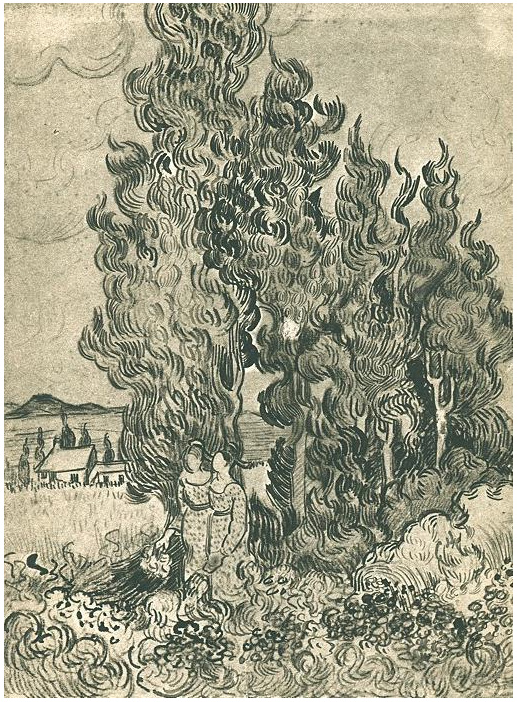
Many of Chelsea's doors are locked not because it's summer, but since Cheim & Read has Joan Mitchell's Trees what's the point? I have been reading about Riopelle: her earlier paintings here, with him in Vétheuil in the Île-de-France, frame the trees more closely, while the paintings from the early 90s, well after her split with Riopelle and deteriorating health are of orchards from a distance. Riopelle railed against symbolic content, Mitchell was against the Exressionists, calling Willem de Kooning an Expressionist, saying she has more kinship with the Impressionists. Riopelle thought the Impressionists were "cheats" but that Van Gogh was the "extension" of the history of Dutch painting. The Île-de-France inspires a war with Van Gogh, whom Artaud called "bodily the battlefield of.. the problem of the predominance of flesh over spirit, or of body over flesh, or of spirit over both.." with Monet near by. Provence gets you Van Gogh and Cezanne: Picasso holed himself up there to do battle with Manet and Velazquez; Kiefer ties the landscape in to controversial aspects of German history. Mitchell admired Van Gogh a great deal, and would, like him and not Riopelle, call herself spiritual. The show revolves around two paintings of cypresses, the first from '64 can't be reproduced (hence this note). Riopelle said "I don't take anything from Nature, I move into Nature." (which Mitchell doesn't like capitalized, saying "Larry Rubin [William Rubin’s brother] kicked me out because Greenberg 'dropped me.' Because Greenberg said, 'Get rid of that gestural horror.'")

CYPRESSES 1975

13 August 2014

Joseph Cornell, Lauren Bacall box, 1946

08 August 2014

A few weeks ago I became aware of the pronouncement in The Boston Review, which I don't read, that "To confront, reinvigorate, and complicate the conversation about class in contemporary poetics, we are launching a poetry forum with this capacious essay by Daniel Tiffany." They could start by checking the attributions on the quotations and paraphrasing.  I just checked to see if I had forgotten some point that Margaret Cohen made and I hadn't..  I will leave this up here briefly...

"Tiffany cites Margaret Cohen's writings on Gothic Marxism and then moves on to the unattributed conclusion "..not only must the working class destroy itself, but it cannot become fully conscious of itself until it does so."  This is made to sound like a paraphrasing of Cohen's writings on the topic, but nowhere does she make that statement directly or indirectly.  The quotation cited to explain Cohen's concept of Gothic Marxism in the previous paragraph is not Cohen's, but an unattributed passage from David Arnold's Poetry and Language Writing.  Whether this conclusion bears some relation to Tiffany's reading of Gáspár Miklós Tamás or his own wish-fulfillment is unclear, but it is essential that Cohen's sentiments not be so misrepresented by someone cutting, pasting, and stringing together logical constructions about a class culture and tradition apparently alien to him."

02 August 2014

Your commentary is lowercase and not italicized


Susan Sontag: "Let the atrocious images haunt us. Even if they are only tokens, and cannot possibly encompass most of the reality to which they refer; they still perform a vital function. The images say: This is what human beings are capable of doing – may volunteer to do, enthusiastically, self-righteously. Don’t forget."

Sontag also may have helped prompt Commentary editor Norman Podhoretz' fresh attack on Ginsberg and the Beats in 1988 by, as president of PEN American Center, signing Ginsberg's letter in support of Palestinian press freedoms, or maybe, since Norm doesn't confide these things to me, it was Ginsberg going to a Tel Aviv protest to read "Jawah and Allah Battle" that year including the line "Commentary and Palestine Review sent me here!", or maybe it was only a matter of literary taste, as beforeGinsberg's response was classic:

Good old Norman Podhoretz. If he weren't there like a wall I can butt my head against, I wouldn't have anyone to hate. And why hate him? He's part of my world, and he's sort of like the character the Blue Meanie.. did I ever really hate him or was I just sort of fascinated by him? I saw him as a sort of sacred personage in my life, in a way; someone whose vision is so opposite from mine that it's provocative and interesting - just as my vision is provocative and interesting enough for him to write columns against in the newspaper. In fact, maybe he's more honest than I am because he attacks me openly. So I should really respect him as one of the sacred personae in the drama of my own transitory experience.

Norm's son, a marital relative of Elliott Abrams, took over Commentary in 2009...


"Sam, I thought I told you never to.."


25 July 2014

What's up

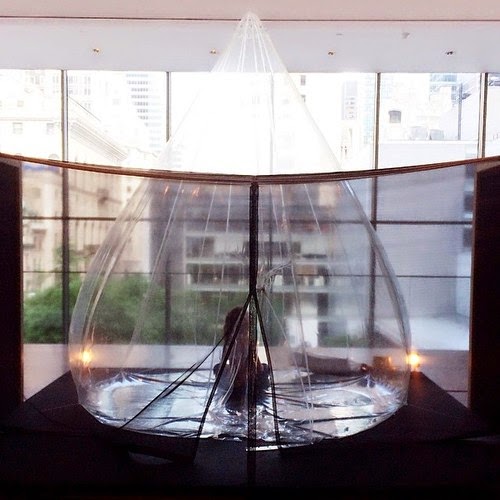
NYC: MoMA's retrospective of Lygia Clark includes her 1968 installation 'The House is the Body' (right), in a way the quintessential Penetrable of the era, wherein one walks into the "Penetration" room as a sperm in a room full of balloons, of which my body mass caused many to escape into the "Ovulation" room until you get into a "Expulsion" room of yarn and mirrors disfiguring your image. Roberta Smith's dismissively calling the work "laughable" in the NY Times is an example of how some of the critical support for amiable folks like Donald Judd like Smith's only drags the artists down by creating an either/or that the they didn't choose. Smith, first of all, accuses the work of lacking verisimilitude as a representation of a woman's experience of childbirth without taking the time to read the card next to it that explains it's not about that, accuses the curators of letting it be "reverentially presented by itself on the fourth floor" in a "Lygia, is that her name? She left this in the hall where the guests can see it" sort of way, then concludes a review untroubled by the historical tradition she is supposed to be writing about by suggesting, perhaps after a midtown lunch spent slapping together a few paragraphs complaining it didn't agree with the Minimalist theory she picked up at the Whitney, that going through it again with the audio guide makes her like it a bit more. Clark was not only making geometric sculptures long before Judd began to, but when Judd made his first sculptures she had already moved onto her tactile works that allowed the visitor to partially 'manipulate' them, to use a term from Oiticica's 1974 "New Objectivity" manifesto which contrasts the Supersensorial works from what he terms the 'semantic' reception of Minimalist sculpture, "to 'communicate' something which.. is fundamental.. large-scale, not for an elite reduced to 'experts,' but even 'against' this elite, with the proposition of unfinished, 'open' works." Could Ariella Burdick at Financial Times reasonably be called an expert? "The encounter group meets the neo-primitive ritual, giving birth, as it were, to a groovy mysticism. That shaggy ethos has not aged well and, like almost everything else in this arid show, seems almost brutally dated." At FT the groovy Sixties were spent intentionally misreporting the Gulf of Tonkin incident and the wars and military governments to follow, which has aged so well that James Petras said a few months ago "The Financial Times should change its name to the Military Times."

The starting point of South American Constructivism is Argentina after the Revolution of '43 freed expression slightly, followed by architectural works that complimented the economic expansion in Venezuela during the Pérez Jiménez dictatorship of the 50's, art more to the liking of FT than the influential critic Marta Traba (1974) "it is true that I deem the Venezuelan kinetic art (I am referring to.. geometric abstraction, Concrete art..) to be a sort of official art that has proved convenient for the ruling classes and the economic powers since it caters as much to their ideology as to their snobbery. It is true that I have repeated and hammered this incessantly, in an open campaign, because I believe that in our countries ideas can no longer be solely expressed, instead they have to be fought for tooth and nail so some minimal attention can be devoted to them. this does not mean that I have stopped appreciating kinetic art.. my openly admitted admiration for.. [Donald] Judd should prove this.. In this space odyssey (of the ruling classes representation of progress) it is obvious that the present is being erased, with increasing force, and the contempt for the past is constantly growing... a society that embarks on such comic book futurism disconnects itself from its problems, and that nothing could be more convenient for its rulers than the projection of their people onto the backdrop of the future, where everything enters a context as Utopian as it is harmless."

Fernando Guillar's 1959 Neo-Concrete Manifesto cited Merleau-Ponty's denunciation of "the concrete rationalists who still think of human beings as machines.." to say "We do not think of art as a 'machine' or as an 'object,' but as a quasi-corpus' (quasi-body).. which can be only understood phenomenologically.. a work of art transcends mechanical space.." paving the way for Oiticica, Clark, and Lygia Pape's Sensorial works of the mid-60s. The point of departure of Merleau-Ponty's Phenomenology of Perception is his exposition of "Sensation" which Husserl set forth in 1907's Thing and Space, both phenomenologists prioritizing tactile sense perceptions; in 1965 Clark writes about her Bichos ("Beasts" as imperfectly translated, metal sculptures the spectator is encouraged to touch, pictured left) "a total, existential relationship can be established between you and him." Both Husserl and Merleau-Ponty studied Buddhism and were likely influenced by the discourses in the Brahmajala Sutta when Buddha describes "the relishing of sensations, the danger of them, the release from them." In the Satipaṭṭhāna Sutta, as described by William Hart "four dimensions of reality are common to every human being: the physical aspects of body and sensation, the psychic aspects of mind and its content. They provide.. the four vantage points for observing the human phenomenon." All four dimensions are covered in Phenomenology of Perception, which cites the Existentialist Heidegger (student of Husserl's) in support of his assertions while quibbling with Heidegger's notion of time and conveniently ignoring Sein und Dasein.

Her son's film O Mundo de Lygia Clark documents her movement into interactive works in which the viewer becomes a participant, which began around the time of the Bichos and continued for three decades while she would "abandon" art for long stretches of time to practice therapy. In the MoMA show, which employs "facilitators" to enact and at times invite visitors to join in, the film is shown in fragments in on different walls and I first saw the footage of her walking on the beach before the show opened and was much entranced. The device at 2:00 is a tube that you are to twist into a circle and hold where it is joined so that the air can go in and out. At 3:30 is the rock on top of an inflated plastic bag that is to suggest pregnancy when held against the chest amongst other things. At 5:00 is the sensorial work "Cannibal" (c. 1973) in which the blindfolded participants eat fruit out of the pocket of someone lying on the ground, mindful of Oswald de Andrade's 1928 essay "Cannibal Manifesto." "..they who came were not crusaders. The were fugitives from a civilization that we are devouring.. In order to transform them into totem." At 8:30 is a plastic bag full of water and small shells which was made available in the Cullen Education Center. I was told it was good to put over the ear, and indeed it was as I liked to bend sideways at the waist with the sound of the shells sliding back and forth above it. From 13:30 for a few minutes is 1974's "Elastic Net." At 24:50 is "Anthropophagic slobber."


As Claude Lévi-Strauss' 1949 essay "The Effectiveness of Symbols" compares the work of a shaman and a psychoanalyst, the therapeutic methods of Clark, who lived in Paris after 1968, resemble those of Lévi-Strauss' shamans: "The shaman plays the same dual role as the psychoanalyst. A prerequisite role - that of the listener for the psychoanalyst and of orator for the shaman - establishes a direct relationship with the patient's conscious and an indirect relationship with the unconscious.. The patient suffering from neurosis eliminates an individual myth by facing a 'real' psychoanalyst; the native woman in childbed overcomes a true organic disorder by identifying with a 'mythically transmuted' shaman.. the shamanic cure seems to be the exact counterpart to the psychoanalytic cure, but with an inversion of all the elements.. in one case, the patient constructs an individual myth with elements drawn from his past; in the other case, the patient receives from the outside a social myth which does not correspond to a former personal state.. the psychoanalyst listens, whereas the shaman speaks." The shamans' use of a synthetic rather than analytical mode resembles the literary workshops of Bhanu Kapil, heavily influenced by Clark, and CA Conrad, who occasionally recounts his considerable childhood trauma but pursues what could be called mythic transmutations in groups, setting aside his often thoughtful, original literary analysis for other times. Clark mostly created these relational works in solitude, one of the reasons they appear incongruous to socialized behavior, though many of the ideas acted on came through the pipeline of her artistic milieu, and the synthetic nature of her training in architecture, reinforced by Concretism, may have prodded her in that direction, away from the analytical.

I particpated in "Life Structures" in which each participant was to get on the floor and tie rubber bands in knots emerging from a single rubber band in two arm-like elastic limbs extending out, exchange the limbs, and dance and climb inside as the circle of rubber bands in the middle gets smaller, which resembles a Catalan Sardahna in some ways (only with purses to the side) as well as the notion that each participant's thought and essence was a spoke on a wheel or limb of a tree. I came late as I followed my attentions to the Gauguin prints in what seemed like performative down time in Camp Lygia, then I never developed a remembered system for tying the rubber band knot making me rather slow at the task as I focused rather on observing as many aspects of what was happening as possible in an irreverent reverence or vice versa; my inclination to dance or move within the knot was hampered by visiting the Halal Guys across the street so as to not get hungry in Taniguchi's floor plan (discussed further below). People spoke different languages but there was a rare sense of communication between us. A stodgy couple selected me to ask what the deal was and I shrugged my shoulders, which the facilitators seemed to like. The guard, a Trinidadian country girl who gave me a full run down on the best places to get Pelau in the boroughs, let participants touch most works but to my delight enforced the no photos whatsoever rule strictly. I felt more grounded in the analytical than most, observing perhaps Buddhistic non-attachment to O Mundo de Lygia and the world that was not her, about which Gauguin's illustrations were in closest proximity.

Dubuffet, Cinq et un six
Amid the summer group shows is - sort of a group show - where Acquavella pairs Dubuffet's portraits and "inventories of terrain" with those of his follower Miquel Barceló whose white paintings resembling abstractions reference a specific natural or architectural object: "'abstract' as I said before, means 'to come from.' (Riopelle)" Dubuffet is the last portraitist I like and the small selection here contains some gems, whereas in the room of "Texturologies" Barceló the pupil stole the show for me.  Gagosian's Ed Ruscha room has a variety of his works for two more months including some interesting photos and they have the some dude's readymades there til August 8.

Chicago:  If you missed the Magritte show at MoMA you're better off seeing it here (til Oct 13), as it not only unlike NY "marks the first time since they were hung in [Edward] James’ Wimpole Street house that these three radically different works (“On the Threshold of Liberty,” which is in the Art Institute’s collection, plus “The Red Model” and “Youth Illustrated”), have been brought together," not only because the lighting recalls the dark main room of 1938's Exposition Internationale du Surréalisme in which the viewers were given flashlights, not only because there are other works here that were not at MoMA, but the way the pathway leads to rooms that feature a single work recalls a great museum of old... NY MoMA before they renovated in favor of thin, crowded hallways leading to vast rooms with masterpieces and visitors jostling and distracted.  Remember when you went down that corridor and the de Chiricos were there all by themselves? well.. it's sort of recalled in the Art Institute's Magritte show.

DC: A week remains of the Mexican Cultural Institute's display of Octavio Paz artist books, which contains works by Motherwell, Cage, Twombly, Tapies, and Tamayo.  To my liking there are several works on paper by Gunther Gerzso, Paz' wife's collages which are quite good, and illustrations of Hanuman creating grammar.. Free, air conditioned, and a Roberto Cueva del Río mural going up the stairs.

Philly: The curators have yet to endorse my theory that being hired to do the Minotaure cover in 1933 brought on Picasso's Minotaur phase, but you can't argue with the Vollard Suite, which is only up til August 3rd.

Boston: The African North of Brazil is represented in a small room adjoining the Sargents in works where the lines between religious iconography, domestic life, and imagination are unclear.  Sense a geographical theme here?

24 July 2014

Thanos Mikroutsikos singing "Of Poor Old B.B."


"Of Poor Old B.B."
 ....

3
I’m friendly to people. I put on
A stiff hat like they do.
I say: they’re animals with a quite particular smell
And I say: it doesn’t matter, I am too.

4
Mornings I sit a few women
In my empty rocking chairs now and again
And I look at them nonchalantly and tell them:
In me you’ve got a guy you can’t rely on.

5
Evenings I gather men around me
We address each other as: ‘gentlemen’.
They’ve got their feet on my tables
And say: things are getting better. And I don’t ask: when?
,,,,

12 July 2014

My Charlie embeds


Everyone has their own particular tastes in Charlie collaborations.. I can't pass up Don Cherry on pocket trumpet, Dewey Redman on tenor sax, Ed Blackwell on drums, Molde, Norway, 1979..
.


And no, I didn't know about this one til I searched on Youtube, at which time I embedded it by Pavlovian reflex.. (actually quite good) McCabe's Guitar Shop Santa Monica, CA, 1984..
..

11 July 2014

Beuys' Lightning with Stag in its Glare 1958-85 (below) "enacts a dramatic moment in nature: A bolt of lightning.. strikes the ground, illuminating a stag..  According to Beuys, the stag is a guardian for the Primordial Animals, which squirm on the floor without intelligence or direction. These simple creatures, like the dramatic Lightning, were cast from a pile of loam.." Tonight's moon (and tomorrow morning's), one of three loosely defined perigree moons with August's full moon being the closest the moon gets to the earth, is alternately referred to as the Buck Moon and the Thunder Moon.

22 June 2014

Since Alain Resnais died I have been re-watching the films and will post about them some time. Harvard Film Archives - which Charles Olson once introduced for - is projecting them these days in a Le Corbusier-designed theater.. if you're nearby tonight at 7pm is the masterpiece La guerre est finie, next Saturday the 28th at 7 is Muriel, or the Time of Return (my favorite of his, which I will attempt to catch), and Monday the 30th at 7 Providence. The ones I named are the ones I recommend, which doesn't include Last Year in Marienbad, which I consider a valiant attempt to make Robbe-Grillet cinematic as I may elaborate on in said post. I don't know what was available to the nice folks at the archive but the films I consider better than Marienbad (and the others they feature like Wild Grass) of those within reach here, in order of preference: 1. Muriel, 2. Hiroshima, Mon Amour, 3. Le Guerre Est Finie, 4. Providence, 5. La vie est un roman, 6. Night and Fog (short; his short films on Van Gogh, Picasso and Gauguin would also roughly place here), 7. Mélo, 8. Love Unto Death, 9. You Ain't Seen Nothing Yet.