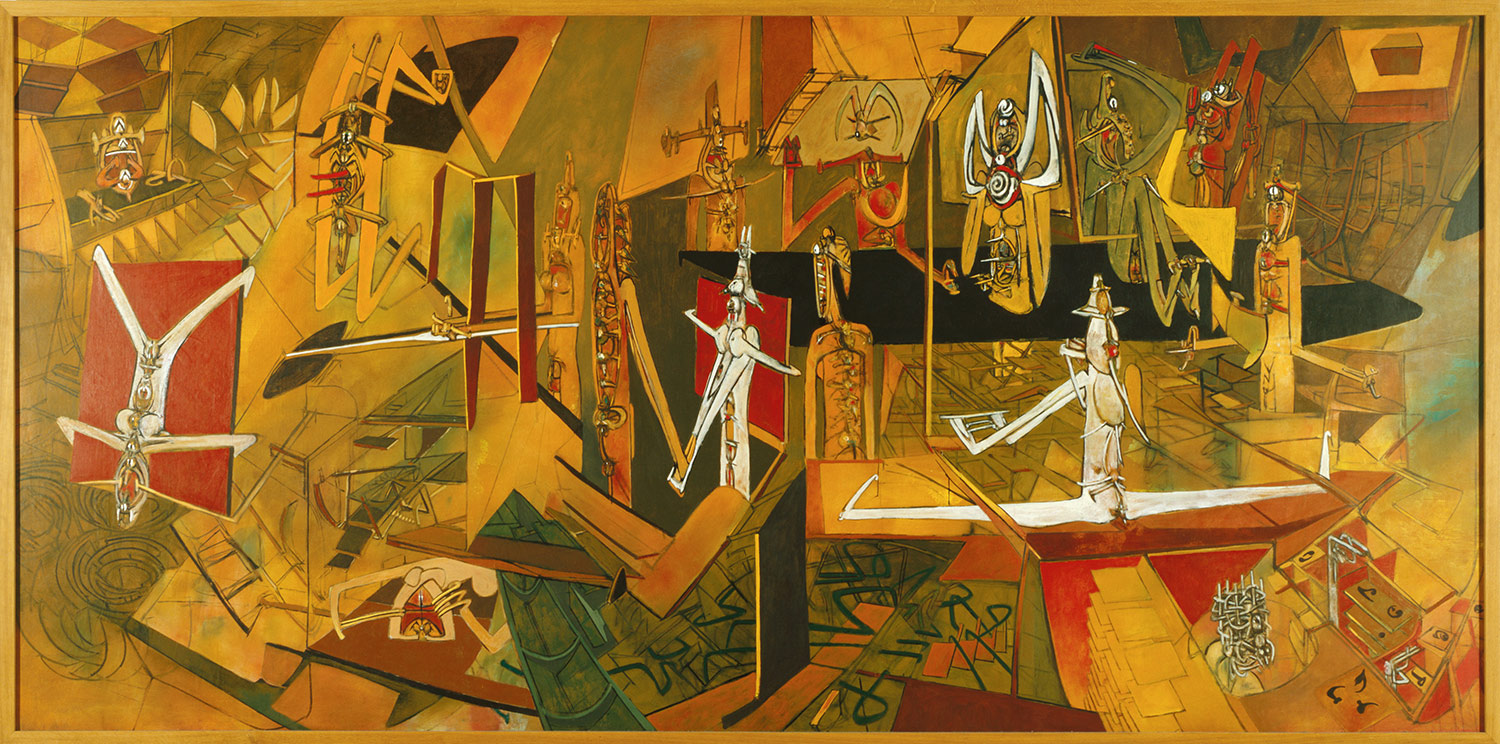
Badiou drew crowds on his East Coast tour, as many people were turned away from getting into the New York lecture and possibly Philly’s.
His Wikipedia page was a paragraph when I was recounting his commentary last weekend, and it’s grown considerably since the tour.
He’s undoubtably enjoying his stardom in the US after over three decades of departmental struggles in Paris. He has fun with English as the directness with which he expresses his ideas in English helps them pack a punch.
His first book translated into English was
Deleuze: The Clamor of Being, I presume because the market for good Deleuze books in English preceded the market for Alain’s own inner thoughts. That’s also the first book of his that I looked at, at the Minnesota MLA booth last December when an editor from the Southwest struck up a conversation and started to get me into him. When I got home I scoured the used internet pool for a few books which I read in dribs and drabs until he stated his positions more directly on the tour.
Since part of Badiou’s star comes from a yearning for a
Paris 8 standard bearer, it is interesting to see how his ghosts line up (for the boardwalk shooting gallery). First of all, Badiou’s school spirit pervades his evocation of May ‘68 more than Paris 8's old titan Foucault, who used to brag that he was in Algiers at the time where the real shit was going down.
Like Foucault, he cut his teeth with Althusser as a teacher, and both defended Althusser during Louis’ down years when the bureaucratic pricks were taking their shots. As I’m fond of saying, if you defend your mentor only out of loyalty, s/he’s not your mentor. Badiou writes constantly of the ‘return of philosophy’ while Foucault frequently said that he wasn’t a philosopher. This may have related in Foucault’s case to that stage of structuralism and not wanting to be weighed down by the demands of sorting out questions of traditions, a function that Badiou relishes in his own way. Both referenced Althusser rarely, if ever, in their work. Just as Althusser said avoiding ideology is ideological, avoiding Althusser the mentor is Althusserian, and their divergent approaches can speculatively be seen this way. The Sartreanism of avoiding Sartre is another can of worms here.
Oliver Feltham’s intro to
Being and Event touches on this, noting (xxvii, Continuum) the ‘encounter’ between Althusser andthe École normale supérieure’s
Cercle d'épistémologie in the 60s and the ‘comparable rupture’ of the ‘lineage of Bachelard, Koyré, Canguilheim and Foucault.’ He then says ‘none of these discourses or authors are privileged in the emergence of the thought of the event, instead Badiou turns to Mallarmé.’ Nowhere in this paragraph or anywhere near it or related to this logical construction do we find the name Deleuze, despite the outline of the rupture from the dialectic and the ensuing integration of Mallarmé in that context obviously coming from Deleuze's
Nietzsche and Philosophy. Deleuze is only mentioned in that intro twice: the assertion that Badiou has broken from the self-reflexivity of Derrida, Hegel and Deleuze, when, of course, Badiou’s position with regard to Hegel is a resigned reiteration of Deleuze’s, and noting Deleuze’s objection that Badiou’s thought was analogical.
This omission cannot be underestimated. Badiou’s Althusserianism back in the late 60s put him on a departmental collision course with Deleuze who came to the Paris 8 department with a circle of allies fresh from the glory of
Anti-Oedipus’ reception. Badiou got to taking shots at Deleuze and by his account, things got tense when Deleuze thought Badiou’s ‘Bolshevism’ was attempting to wrest control of the department from the ‘troika of Deleuze, Châtelet, and Lyotard,’ which ‘retook "power" without resistance.’
What no one seems to say is how Deleuze seems to have taken power over Badiou’s view of the dialectic without resistance, since Deleuze’s attacks on Hegel and the dialectic in
Nietzsche and Philosophy on ‘behalf’ of Nietzsche seem to loom as assumptions which pave the way for Badiou’s work. Deleuze came up with the concept of a rupture from the dialectic making use of ontology, since the Nietzschean opposition of being and non-being could not be synthesized, an approach that takes the form of an assumption in Badiou.
Nietzsche and Philosophy is notably not one of the nine books of his that Badiou cites in
Deleuze, citing instead Deleuze’s commentary on Mallarmé from their personal correspondence. For those of you that haven’t hung around me much, I think that
Nietzsche and Philosophy is Deleuze’s most important work, and despite its title the most Deleuzean. The Guattari collaborations are thought-provoking, getting overly cute in
A Thousand Plateaus, ending with the indispensable reflection of
What is Philosophy? Pure Immanence is the pared down, most direct and perhaps enduring of his propositions.
Despite building extensively on Deleuze’s ontological approach, Badiou has his ways of staking out a middle ground within the apparently incompatible rupture between Deleuze and Althusser, the ripples of which go back to when Schopenhauer would schedule his lectures at the same time as Hegel’s out of spite. Badiou, on the structures and universal truths of non-ontological situations:
"..my thesis is that in a situation there is always an encyclopedia of knowledge which is the same for everybody. But the access to this knowledge is very different. We can speak in Marxist terms, we cans say that in a situation there is an ideological
dispositif [apparatus] which is dominant - in the end it’s the same thing.
Justin Clemens: "Would you say Marxism talks about encyclopedic knowledges but doesn’t talk about the truth?
Badiou: "No, no I think that Marxism, the category of Marxism designates the same thing that I designate by the
dispositif of the encyclopedia of knowledge. But in Marxism there is a series of truths, which is different from ideology." (
Infinite Thought, 171-2)
It is sort of comical in that context that Simon Critchley, Badiou’s designated opponent on the West Philly fight card, in his exhaustive examination of the options presenting themselves to the Anglophone philosopher, noted an affirmative interest in a Third Way, sheepishly admitting its being a Blairism while we sat safe from the explosive devices in Baghdad. Critchley stood in the ring as one of the ‘anarcho-desirers’ that Badiou had taken on for years so there was no affirmation of the dialectic coming from either side, just the Third Way, as the Third and First ways never do take the time to lift a finger on behalf of the dialectic that forms the basis of their existence. As Blair, Gordon Brown and the others have proved once again, the Third Way is the First Way without the baggage. In the context of Badiou’s refinement of Deleuze’s critique of the dialectic, we can see the Third Way as an embodiment of the reductive, irrelevant, fabricated side of the dialectic, containing nothing of Athusser’s increasingly convincing and resilient case that all thought is ideological.
Badiou touches more on the dialectic in 2006's
Logiques des mondes, which I don’t think has been translated, wherein he sets forth a Third Wayish ‘democratic materialism,’ making a third out of what in the other two is not hegemonic. Žižek
not surprisingly accuses it of ‘Eating the cake and keeping it’ suggesting the little victories of the new are ‘his all too crude opposition between repetition and the cut of the Event, his dismissal of repetition as an obstacle to the rise of the New..,’ pitting Deleuzean repetition against the Badiouian event. Badiou’s position is not really Third Wayish in that it’s not a compromised one, though, but one of rupture, of what Žižek reductively calls Big Change while critiquing its indifference to incremental reform.
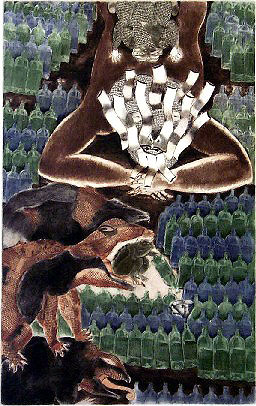

 One more week of this show, the best on the East Coast now and the first, though way too small, US retrospective of Toledo in years and years. I’ve never seen his drawings and the draftsmanship is strikingly original. His works presented together enable you to inhabit his mythical logic, play of masks, and mirror hall of sacrifices, ‘the gods had to die.. The wind tore out their hearts and used them to animate the newborn stars.’ (Sahagún)
 Toledo’s daughter Natalia has poetry, some of which is written in Zapotec, featured in the Copper Canyon Mexican anthology but has yet to be translated book-length; this portrait of her is most likely based on erotic photos of Francisco in his youth in snake and alligator skin.