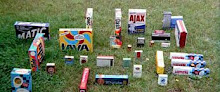
Paco obviously could have had any set up for Saura's Flamenco and he chose a circle in which he sits before what appears to be the sunset in an imagined pre-industrial Spanish coast, accompanying his brother Pepe's singing as when he was growing up..
Here in 1972, around the table with his brother for Bulerias "
The "Mediterranean Sundance" perf in Friday Night in San Francisco is I think one of the hardest songs to get sick of, and before you do.. this version has the video of Paco's fingering..
A rumba from the early 70s.. with Camarón..
27 February 2014


31 January 2014
What's up for two more days and a few months out west
 |
| Craft Morphology Flow Chart |

Pay For Your Pleasure (above), created for the Renaissance Society of the University of Chicago, consists of a hall of blown up, institutional posters of authors and artists implying their practice is the sublimation of the criminal mind "I do not understand laws. I have no moral sense. I am a brute" (Rimbaud) "If you encounter charlatans, reason with them.. if they resist, be bold enough to drown them" (Giotto) "I erect myself at the exact point where knowledge touches madness, and I can erect no safety rail" (Balzac) "I call 'monster' all original, inexhaustible beauty" (Jarry) leading to the 'low art' of the work of an actual local criminal which is studied to decipher their psychology. I saw this installation in his previous retrospective and the criminal's work was an uninteresting portrait - this time the criminal's was good enough, a sort of cosmological abstraction, that I thought the previous concept had been forgone and a work of Kelley's had been inserted - as he is all over the map graphically, including attempted skill levels. A hallway is typically decorated to condition the visitor to the decorum sought in the rooms and this does the opposite, as when he proposed*** to decorate an office complex by blowing up cartoons on secretary's desks to a large scale, placing "If assholes could fly, this place would be an airport" in large letters next to the conference table. The exhibition includes From Our Institution to Yours (below) in which he blew up drawings made by his art school's security guards, warning the working class against 'false images,' as the personification of animals exists in church and state as well as folk art and cartoons.

 | |
| I think Mike wants us to see Accatone soon |
The snowfalls have left Clyfford Still-like markings on the exterior of PS1, and Still would be an example of an artist for whom a single work has a resonance which, if somehow quantified, could score relatively favorably against the resonance of his entire oeuvre - Kelly, despite flashes of mastery of materials and inventive draftsmanship, inhabits the other side of that scale, as he was prolific and evocative with a minimum of repetition, so conducive to the Posthumous Retrospective space this is. Despite his many imitators, there will never, ever be another show like this one.
* His We Communicate Only through Our Shared Dismissal of the Pre-linguistic: Fourteen Analyses was a critique of the socialization of art
** ..after Art Institute of Chicago rejected him because he was 'too Chicago' as they were trying to copy Baldessari at Cal Arts
*** Proposal for the Decoration of an Island of Conference Rooms (with Copy Room) for an Advertising Agency Designed by Frank Gehry
16 January 2014
invadieron el muerte..
A bird lived in me.
A flower traveled in my blood.
My heart was a violin.
I loved and didn't love. But sometimes
I was loved. I also
was happy: about the spring,
the hands together, what is happy.
I say man has to be!
(Herein lies a bird.
A flower.
A violin.)
-Juan Gelman, Epitaph, tr. Ilan Stavans
"You see, that's what I said with my poem. Everybody waits for the next death of the next late great jazz musician. That's what it concludes with, sayin' everybody is waitin'. Like all the record company pirates put out legendary performances of all types of stuff that wasn't around when you were alive. It's like everybody waits 'til you're dead, then you get all the recognition. But what good is it when you're dead, if you're alive right now and you're not gettin' recognition, you know what i mean.." (Roy Campbell, Jr.)
In a book of verses spattered
with love, with sadness, with the world,
my children drew yellow ladies,
elephants trudging across red parasols,
birds imprisoned in the margin of a page,
they invaded death,
the large blue camel rests above ash-gray words,
a cheek glides across the solitude of my bones,
candor defeats the disorder of the night.
-Juan Gelman, The Victory, tr. D.J. Flakoll & Claribel Alegría
"A heart stops, another starts, it beats and bleeds within the chest, it whispers, it speaks the truth – listen! The soul, sometime staggering under life’s challenge, is straining every unseen fiber, then desires and fears are seen no longer; the soul is but a stillness somewhere in space. The heart speaks to the soul. Listen to this internal dialogue. See with the eyes of the heart; Listen when it speaks, for the heart is born pure." (Yusef Lateef)
The main thing
to be against
is Death!
Everything Else
is a
Chump!
-Amiri Baraka, Ancient Music
A flower traveled in my blood.
My heart was a violin.
I loved and didn't love. But sometimes
I was loved. I also
was happy: about the spring,
the hands together, what is happy.
I say man has to be!
(Herein lies a bird.
A flower.
A violin.)
-Juan Gelman, Epitaph, tr. Ilan Stavans
"You see, that's what I said with my poem. Everybody waits for the next death of the next late great jazz musician. That's what it concludes with, sayin' everybody is waitin'. Like all the record company pirates put out legendary performances of all types of stuff that wasn't around when you were alive. It's like everybody waits 'til you're dead, then you get all the recognition. But what good is it when you're dead, if you're alive right now and you're not gettin' recognition, you know what i mean.." (Roy Campbell, Jr.)
In a book of verses spattered
with love, with sadness, with the world,
my children drew yellow ladies,
elephants trudging across red parasols,
birds imprisoned in the margin of a page,
they invaded death,
the large blue camel rests above ash-gray words,
a cheek glides across the solitude of my bones,
candor defeats the disorder of the night.
-Juan Gelman, The Victory, tr. D.J. Flakoll & Claribel Alegría
"A heart stops, another starts, it beats and bleeds within the chest, it whispers, it speaks the truth – listen! The soul, sometime staggering under life’s challenge, is straining every unseen fiber, then desires and fears are seen no longer; the soul is but a stillness somewhere in space. The heart speaks to the soul. Listen to this internal dialogue. See with the eyes of the heart; Listen when it speaks, for the heart is born pure." (Yusef Lateef)
The main thing
to be against
is Death!
Everything Else
is a
Chump!
-Amiri Baraka, Ancient Music
29 December 2013
 Three shows of paintings on the Upper East Side this week: James Rosenquist at Feigen (34 East 69th Street, til Jan 10) centers around two large-scale paintings from 1973, but for those (like me) who didn't see the forty foot long version of his Holy Roman Empire Through Checkpoint Charlie at the 2006 Art Dealers Association show, a smaller version is there on lithograph, as well as a 2004 litho of The Xenophobic Movie Director or Our Foreign Policy (right), a selection of other paintings, and Rosenquist-related works by Ray Johnson.
A sampling of Peter Doig's early canvases are at Werner (4 E 77th St) til Jan 4th (below, Red Siena); these will apparently not be in his retrospective that runs Jan 25-May 4 in Montreal.

Iran Modern (til Jan 5): This was my first visit to the Asia Society and as Piri' Miri Muli' readers would no doubt expect, the listings in the 1991 Blue Guide put lofty notions in my head about seeing the 50 2ndC sculptures from Kushan period of North India etc. but the price of admission doesn't mean they have room for a permanent and temporary show at the same time, because the upper floors consist of conference rooms set up by the Rockefellers to foster better relations between the US and Asia, and the Iran show has been in the works for well over a year (insert conspiracy theory here). Their timeline is available online, in which the curators don't omit recollections like "In August (1953), as Iran continues to suffer economically due to its blockaded and boycotted oil industry, the CIA, British Intelligence, and a cadre of Iranian military leaders engineer a successful coup to overthrow Mosaddegh and replace him as Prime Minister with a Shah loyalist general" and "with aid from allied intelligence agencies based in the United States and Israel, the Shah founds SAVAK (in 1957), an internal security service soon to become notorious for its zeal and ruthlessness in hunting down political dissidents in all arenas of public life"; included is a photo of a large crowd of women protesting in support of the Ayatollah in 1978. The threat of SAVAK is portrayed in the two paintings of Nicky Nodjoumi here; a wider selection of his Neo Rauch-like tableau are reproduced on the Taymour Grahne site from their Nodjoumi show last fall.

28 December 2013
A policeman was telling me recently the yuletide brings calls of (1) suicides; (2) domestic violence; (3) family fights; (4) relatives that threaten gatherings they're not invited to, as well as the other stuff..
It almost escaped the attention of Piri' Miri Muli' that someone has been uploading a lot of Andalusian Villancicos Navideños this winter.. I embeded La Macinita's from the Saura/ Storaro film a few years ago which is still my favorite Xmas video and it will likely remain that way,* but he uploaded that one w/ better pic and sound (but you'd have to check out the dvd for the English translation**)..
and a Camarón Villancico with Tomatito..
and one of Carmen Linares'..
This Lavoe/ Colon Asalto Navideño has some merry Yomo Toro solos..
Ah that concert.. from 1978.. I suppose this isn't an Xmas song unless they're telling Santa it's a bad neighborhood but it's Hector-ific especially near the end..
Here they're telling Santa he and Mrs. Claus are yesterday's news, unless they mean someone else. It's all about Santa all the time here tho..
* Last years' embed was close, a tune I first heard, as Piri' Miri Muli' readers know, accompanying Alain Sechas' installation Les Suspects rotated into the Pompidou permanent collection.
** Basically Joseph and Mary are broke and they need a room..
It almost escaped the attention of Piri' Miri Muli' that someone has been uploading a lot of Andalusian Villancicos Navideños this winter.. I embeded La Macinita's from the Saura/ Storaro film a few years ago which is still my favorite Xmas video and it will likely remain that way,* but he uploaded that one w/ better pic and sound (but you'd have to check out the dvd for the English translation**)..
and a Camarón Villancico with Tomatito..
and one of Carmen Linares'..
This Lavoe/ Colon Asalto Navideño has some merry Yomo Toro solos..
Ah that concert.. from 1978.. I suppose this isn't an Xmas song unless they're telling Santa it's a bad neighborhood but it's Hector-ific especially near the end..
Here they're telling Santa he and Mrs. Claus are yesterday's news, unless they mean someone else. It's all about Santa all the time here tho..
* Last years' embed was close, a tune I first heard, as Piri' Miri Muli' readers know, accompanying Alain Sechas' installation Les Suspects rotated into the Pompidou permanent collection.
** Basically Joseph and Mary are broke and they need a room..
20 December 2013
What's up for two more days
 |
| Medal for Dishonor: Propaganda for War |
 |
| Medal for Dishonor: Elements Which cause Prostitution |
 |
| Medal for Dishonor: War Exempt Sons of the Rich |
Since I started writing this post, the gang was good enough to extend the Smith show til Jan 11, but at 980 Madison the late de Koonings and William Eggleston 1978 sky images are ending, and next door, the Balthus photos make a great date if for some reason you want your girlfriend to dump you. Midtown: Kabakov at Pace, ending, and on 19th Street the lines will be very long for the last day of Yayoi Kusama's Infinity Rooms but if you show up at 10am it should be warm enough.
* All fifteen were shown at Matthew Marks in 1994-95.
07 December 2013
What's up


Smithson's explanation of the Non-Site: "The Non-Site ... represents an actual site in New Jersey. It is by this dimensional metaphor that one site can represent another site which does not resemble it - this The Non-Site. To understand this language of sites is to appreciate the metaphor between the syntactical construct and the complex of ideas, letting the former function as a three dimensional picture which doesn't look like a picture. 'Expressive art' avoids the problem of logic; therefore it is not truly abstract. A logical intuition can develop in an entirely 'new sense of metaphor' free of natural or realistic expressive content. Between the actual site in the Pine Barrens and The Non-Site itself exists a space of metaphoric significance. It could be that 'travel' in this space is a vast metaphor. Everything between the two sites could become physical metaphorical material devoid of natural meanings and realistic assumptions" relates to Piri' Miri Muli' themes (at times incorporating Smithson) of the interpretation of the visual world - for instance, Chogyam Trungpa's "samsara is the entrance, samsara is the vehicle for nirvana" preceded immediately by "there is active behavior, then passive, then active.. the first moment producing and giving birth to the next.." Daumal's wanting to see Mount Meru was paradoxically an active desire for the passive, while the Smithsonian and Cagean view of the ubiquity of the resonance of the material world was passive in its observation of, active in its recording of, a subject which was both passive and active. Daumal at different times would seem to appear in three points of Deleuze's Nietzsche and Philosophy schema: as the artist/master, as the top level of reactive ressentiment (towards Breton) and as the ascetic man, in his devotion to Gurdjieff. Deleuze: "the fiction of a world-beyond in the ascetic ideal.. is what gives the world a value of appearance or of nought.. the ascetic ideal (also expresses) the affinity of reactive forces with nihilism as the 'motor' of reactive forces." Gurdjieff thought that artist should not arrive at meaning unwittingly, differing from the views of Hegel and Adorno, while Daumal, a year before he met Gurdjieff, wrote about Rimbaud "the object of criticism.. is to show luminously how the poet wrote a necessary corpus of work, bound by a rigorous determinism to the whole of the contemporary world, and supported by a law just as perfectly inflexible.. This freedom, the source of all values is (as Spinoza understands it, and any other meaning is impossible) that of the man who frees himself by thinking of himself as determined by universal will." In Daumal's schema the active poet is valued over the "useless, sterile, odious" passive poet.

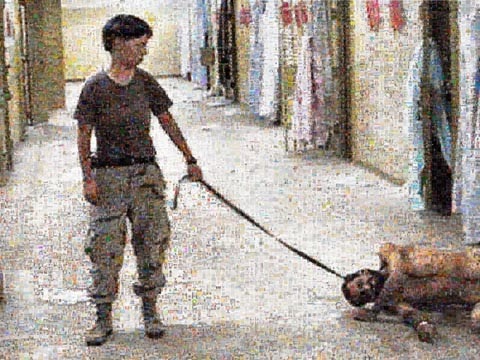
* Frick was known for collecting light works of art. I suppose I would like the Grounds better if Johnson did a three dimensional Third of May or, as Joan Fontcuberta is featured in the Princeton show, his Googlegram 5: Abu Ghraib would look good there as a sculpture for photo ops..
** Route 33 only seems to have an exit for northbound though, on your way out. If you're going S, I guess you can take Klockner Rd. N to State Street E
Subscribe to:
Posts (Atom)