I have recently registered the blog spots for eight Ian Guides to cities and hope to get the time to fill them out, which sadly may mean a break from internet BBQ writing. At times my compulsion that people going somewhere don’t miss important things gets awkward, as with two occasions when people going to Paris for a few days got 16 page emails, so by putting this online I don't assign an itinerary burden to one recipient.
The new Paris guide is up and I declare it an instant classic to be printed out for the plane or the familiar armchair. My personal incentive for writing this can be found in the Montparnasse section.
The classic works of travel memoir have created a caste system in which function is assigned a lesser value. The Norton Anthology of Travel, which includes only English language essays without noting this criteria for omission, says in its introducton by Paul Fussell, whose ignorant pomposity can be seen in his criticism of Alice Notley: "Guidebooks belong to the world of journalism, and they date; travel books belong to literature, and they last."
Setting aside the fact that any Blue Guide is eternally more interesting than anything Fussell will ever write, we see why the omission of Ezra Pound's "Europe or the Setting" essay from Guide to Kulchur is necessary - it contradicts Fussell's narrow-minded assessment. The narcissistic arithmetic that so often guides the travel essay lacks the earnest insistence to let the reader see for themselves:
"You have a concentration of treasures that will need al your calf muscles, all your ankle resistance. Perugia, the gallery of the Palazzo Publico.. Ravenna, mosaics.
If any man or young lady will first get his eye-full, this ideogram of what’s what to why some great works of art are from it omitted.
Goya, yes, Goya. The best one I know is in New York.
How to see works of art? Think what the creator must perforce have felt and known before he got round to creating them...
A fugue a week for a year wd. teach even a bullhead something.
Loathe the secolo decimonono. What was good from 1830 to 1890 was a protest. It was diagnosis, it was acid, it was invocation of otherness. Chopin carried over precedent virtue."
I declare both forms infinite. We cannot map the cultural geography of the world with microscopes. I like to drink caffeine in the morning reading rail schedules for places I'm not going. I go to cities because I don't live in one and so I go to gather the new.
30 June 2009


22 June 2009
New on dvd
Tuesday: Last Year at Marienbad. Some of you may have been hoping it'd never come out on dvd, but at long last Criterion has issued a two disc set of the screenwriting of that glorious dead end of literature, Alain Robbe-Grillet. If you wonder how much Robbe-Grillet needs Resnais' direction, how much he was indebted to Surrealism, or generally want to lose respect for him, suffer through La Belle Captive. It's also amazing how many great films Delphine Seyrig is in. Can't wait to see the snappy new print.
also: Waltz with Bashir: haven't seen it and I don't like cartoons, but this uses the format to recover historical memory, so I hear.
Last week: Scott Walker: 30th Century Man. Haven't seen it. Not a long time Walker fan, but I have listened to his recent The Drift more than a few times which is like Ray di Palma writing lyrics for a depressed Prague Rock band. That's a recommendation, in case you're wondering.
Bergman Island: Did catch it this past week and enjoyed it, although if you don't like Bergman there's no reason to bother. Candid interview near the end of his life and a limited tour through his abode. What I liked was how he had a Russian fireplace which had a crevice to lie down to the side of the fire, in which he would stare out at the sea and snowstorms. Near the end he attempts to wrap up his spiritual meditations, coming up with something resembling Tibetan Buddhism: he believes in the divine in living things revealed in great art and music.
also: Waltz with Bashir: haven't seen it and I don't like cartoons, but this uses the format to recover historical memory, so I hear.
Last week: Scott Walker: 30th Century Man. Haven't seen it. Not a long time Walker fan, but I have listened to his recent The Drift more than a few times which is like Ray di Palma writing lyrics for a depressed Prague Rock band. That's a recommendation, in case you're wondering.
Bergman Island: Did catch it this past week and enjoyed it, although if you don't like Bergman there's no reason to bother. Candid interview near the end of his life and a limited tour through his abode. What I liked was how he had a Russian fireplace which had a crevice to lie down to the side of the fire, in which he would stare out at the sea and snowstorms. Near the end he attempts to wrap up his spiritual meditations, coming up with something resembling Tibetan Buddhism: he believes in the divine in living things revealed in great art and music.
20 June 2009

(Ferdowsi square, June 2009)
"
28TH OF JANUARY
PUBLIC PARADE AND GREAT
DEMONSTRATION
OF THE MASSES
AT 9 O'CLOCK TONIGHT
BE THERE! BE THERE!
Learn through Cuba's independence how
to prevent in time United States from
taking over the Antilles and from forcibly
subjecting to their rule countries in the
Americas.
JOSÉ MARTI WILL SPEAK
"
-Nicolás Guillén, 1973, The Daily Daily, tr. Vera Kutzinski
"
28TH OF JANUARY
PUBLIC PARADE AND GREAT
DEMONSTRATION
OF THE MASSES
AT 9 O'CLOCK TONIGHT
BE THERE! BE THERE!
Learn through Cuba's independence how
to prevent in time United States from
taking over the Antilles and from forcibly
subjecting to their rule countries in the
Americas.
JOSÉ MARTI WILL SPEAK
"
-Nicolás Guillén, 1973, The Daily Daily, tr. Vera Kutzinski
16 June 2009

08 June 2009

01 June 2009

31 May 2009
Review: Gallery shows
Sigmar Polke's later work has predictably become more scientific and less psychedelic, more expensive in conception, more theoretically grounded. The series at Michael Werner (4 e 77th, til June 19) relates to a commission to place a sculptural installation in the Reichstag which documents the infinity of differing perspectives based on a treatise on optics by 17th century monk Johann Zahn. It doesn't get any more established than that, but that commission, inconceivable in America whose legislative building is a neo-classical tourist trap effectively controlled from the suburban Pentagon and Langley, represents along with the Reichstag's glass exterior intractable goals towards transparency and cooperation in a nation purged of its own self-sustaining military monstrosity.
Polke's and Gerhard Richter's Capitalist Realism movement of the 60's, presumed to be a pun juxtaposing aesthetics separated at the time by a wall, was in my humble opinyun borne of phenomenological strategies while French movements, abstract expressionism (effectively invented by Ernst, a French denizen with a German name, identity, and passport), and Pop grew out of ontological strategies. Badiou's comparison of Deleuze and Heidegger gets right to the point of these disparate traditions: "It is impossible to overemphasize this point... Deleuze purely and simply identifies philosophy with ontology .. for Deleuze, Heidegger is still and always too phenomenological." (B's Deleuze 19-20) Sartre, of course, attempted to reconcile these traditions and Badiou has recently mustered as much.
This conflict pervades every act of representation, including the portrait, most recently practiced inventively by Giacometti and Dubuffet: are you painting the subject or the act of seeing the subject? The answer to Freud, Pearlstein, Katz and Close is ontological, as if cubism never happened. Polke's figures fluctuate from what comes from his imagination and the 'found' representation: old engravings, newsprint pointillism, cartoons, etc., with found representation usually painted over an abstract background. While the personae wrested from his imagination are seemingly infinite, we don't see a consistent creation of a 'world' that we come to associate with a Miro, Tanguy, or Matta. The found representation usually represents an ideology as well, sometimes Romantic or Arthurian, sometimes from advertising, etc. Lots of etcs when pinpointing his strategy. Parataxis in the German tradition is as present in Hölderlin as it is in Grosz's streetscapes, Beckmann's group shots and Schwitters' collages, and these juxtapositions set forth the relation between the subjects within a painting in a manner different than in Picasso, Matisse and Leger.
As I've done with Lari Pittman, a comparison to Picabia's dark figures is in order. Here's our fuzzy futurist friend:

Here's Polke's Paganini, from 1982:

and then Daniel Richter (no relation), heavily influenced by Polke:

Picabia's and Richter's figures are unified with the other figures in time, while any relation in the Polke tableau - historicized by swastikas - is purely subtextual. This opposition should be kept in mind when viewing Rauch's figures, another of D. Richter's influences.
In the middle you have Belgium, of course, home to figures subject to alienation somewhere between Matisse's dancers and Beckmann's lineups. Magritte:

Delvaux:

Ensor, who's influenced D. Richter:

As the scientific focus of Polke's series allows him to make the theory behind it simpler and more forceful, it interests me visually as a reflection of his more curious, playful youth. I've only looked at the thumbnails up to now but I will try to see the works in person.
Picasso at Gagosian til the 6th on 21st Street. John Richardson's auspicious advisory arrangement with the gallery sidetracks the curatorial bureaucracy of the museums, placing the Andalusian master back in the warehouse district with the new kiddos. Though Pablo's contemporaneousness predictably holds its own, most visitors don't give themselves the frame of reference because they get out of a cab to see just this show and then leave Chelsea altogether when they're done with it. It's crowded, so a weekday is best, early in the morning or right before close on a weekend.
Right next door is Sophie Calle at Paula Cooper also til the 6th. Her boyfriend sent her an email saying 'it's over' and Sophie therein stages the ultimate artistic revenge: instead of attempting the decipher the gesture by sharing the missive with a few friends, she contacts women the world over and makes a major installation of the various responses. Well worth seeing. The boyfriend will call next time. Without unleashing my adjectives on this display, I'll say that my own initial reaction to 'it's over' was that related to something historical or theoretical and not a relationship.. don't read too much into that.
Even though Abel Admessedmed at Zwirner was for me the most powerful of recent shows, Gagosian has, judging by force of spectacle, 'won the spring' hands down. Drawing people's eyes from the other contenders on 24th Street are the giant pumpkins of Japanese veteran painter/sculptor Yayoi Kusama (ending June 27), well worth seeing for yourself. Though the pumpkins can be witnessed sufficiently in a crowd, it's best to arrive at an off-peak time to ensure that you will be given ample time to stand in her "infinity room." It's also good to go in a group of 2-4 people, which the guards tend to be deferential to when deciding whom to kick out when. For me, the "infinity room" evokes the candlelit boats on Lago Patzuaro on the night of the Day of the Dead, but the interpretive possibilities are.. you guessed it. Uptown they have an all-star group show of the figure.
Also worth seeing:
22nd Street: Stephen Shore at 303 Gallery.. revolutionizer of the road trip photo essay.
13th Street: Malcolm Morley. I'm not a Morley fan but it's always something to see. Nascar and cycles I hear.
19th Street: Zwirner's using all the wall space for Alice Neel, with the nudes uptown. A new building has already covered the South side of Shigeru Ban's Metal Shutter Houses across the street but architects live by the sword and..
Oh yeah: Francis Bacon at the Met. Another one you're going to want to see several times weekdays or first thing on a weekend morn. They also have a show of the Pictures Generation - the 80's artists which you and I have varying opinions of, a public hanging that the Met curators are uniquely cut out for as it's their backyard. I should say that when I first saw Robert Longo years ago it was inevitably the isolated mosh pit yuppie shtick (compare to Flemish figures above) which came off as boring brat pack icons back when I had pimples. The recent show at Metro Pictures - it just ended this weekend - was GREAT!! you missed it! it truly was so from a standpoint of draftsmanship chops, and has made me look over his whole career again. I wish he had varied his gaze more and in a way he did if you get past the iconic works that get put up in permanent collections and group shows.
Polke's and Gerhard Richter's Capitalist Realism movement of the 60's, presumed to be a pun juxtaposing aesthetics separated at the time by a wall, was in my humble opinyun borne of phenomenological strategies while French movements, abstract expressionism (effectively invented by Ernst, a French denizen with a German name, identity, and passport), and Pop grew out of ontological strategies. Badiou's comparison of Deleuze and Heidegger gets right to the point of these disparate traditions: "It is impossible to overemphasize this point... Deleuze purely and simply identifies philosophy with ontology .. for Deleuze, Heidegger is still and always too phenomenological." (B's Deleuze 19-20) Sartre, of course, attempted to reconcile these traditions and Badiou has recently mustered as much.
This conflict pervades every act of representation, including the portrait, most recently practiced inventively by Giacometti and Dubuffet: are you painting the subject or the act of seeing the subject? The answer to Freud, Pearlstein, Katz and Close is ontological, as if cubism never happened. Polke's figures fluctuate from what comes from his imagination and the 'found' representation: old engravings, newsprint pointillism, cartoons, etc., with found representation usually painted over an abstract background. While the personae wrested from his imagination are seemingly infinite, we don't see a consistent creation of a 'world' that we come to associate with a Miro, Tanguy, or Matta. The found representation usually represents an ideology as well, sometimes Romantic or Arthurian, sometimes from advertising, etc. Lots of etcs when pinpointing his strategy. Parataxis in the German tradition is as present in Hölderlin as it is in Grosz's streetscapes, Beckmann's group shots and Schwitters' collages, and these juxtapositions set forth the relation between the subjects within a painting in a manner different than in Picasso, Matisse and Leger.
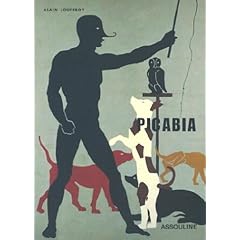
As I've done with Lari Pittman, a comparison to Picabia's dark figures is in order. Here's our fuzzy futurist friend:
Here's Polke's Paganini, from 1982:

and then Daniel Richter (no relation), heavily influenced by Polke:

Picabia's and Richter's figures are unified with the other figures in time, while any relation in the Polke tableau - historicized by swastikas - is purely subtextual. This opposition should be kept in mind when viewing Rauch's figures, another of D. Richter's influences.
In the middle you have Belgium, of course, home to figures subject to alienation somewhere between Matisse's dancers and Beckmann's lineups. Magritte:

Delvaux:

Ensor, who's influenced D. Richter:

As the scientific focus of Polke's series allows him to make the theory behind it simpler and more forceful, it interests me visually as a reflection of his more curious, playful youth. I've only looked at the thumbnails up to now but I will try to see the works in person.
Picasso at Gagosian til the 6th on 21st Street. John Richardson's auspicious advisory arrangement with the gallery sidetracks the curatorial bureaucracy of the museums, placing the Andalusian master back in the warehouse district with the new kiddos. Though Pablo's contemporaneousness predictably holds its own, most visitors don't give themselves the frame of reference because they get out of a cab to see just this show and then leave Chelsea altogether when they're done with it. It's crowded, so a weekday is best, early in the morning or right before close on a weekend.
Right next door is Sophie Calle at Paula Cooper also til the 6th. Her boyfriend sent her an email saying 'it's over' and Sophie therein stages the ultimate artistic revenge: instead of attempting the decipher the gesture by sharing the missive with a few friends, she contacts women the world over and makes a major installation of the various responses. Well worth seeing. The boyfriend will call next time. Without unleashing my adjectives on this display, I'll say that my own initial reaction to 'it's over' was that related to something historical or theoretical and not a relationship.. don't read too much into that.
Even though Abel Admessedmed at Zwirner was for me the most powerful of recent shows, Gagosian has, judging by force of spectacle, 'won the spring' hands down. Drawing people's eyes from the other contenders on 24th Street are the giant pumpkins of Japanese veteran painter/sculptor Yayoi Kusama (ending June 27), well worth seeing for yourself. Though the pumpkins can be witnessed sufficiently in a crowd, it's best to arrive at an off-peak time to ensure that you will be given ample time to stand in her "infinity room." It's also good to go in a group of 2-4 people, which the guards tend to be deferential to when deciding whom to kick out when. For me, the "infinity room" evokes the candlelit boats on Lago Patzuaro on the night of the Day of the Dead, but the interpretive possibilities are.. you guessed it. Uptown they have an all-star group show of the figure.
Also worth seeing:
22nd Street: Stephen Shore at 303 Gallery.. revolutionizer of the road trip photo essay.
13th Street: Malcolm Morley. I'm not a Morley fan but it's always something to see. Nascar and cycles I hear.
19th Street: Zwirner's using all the wall space for Alice Neel, with the nudes uptown. A new building has already covered the South side of Shigeru Ban's Metal Shutter Houses across the street but architects live by the sword and..
Oh yeah: Francis Bacon at the Met. Another one you're going to want to see several times weekdays or first thing on a weekend morn. They also have a show of the Pictures Generation - the 80's artists which you and I have varying opinions of, a public hanging that the Met curators are uniquely cut out for as it's their backyard. I should say that when I first saw Robert Longo years ago it was inevitably the isolated mosh pit yuppie shtick (compare to Flemish figures above) which came off as boring brat pack icons back when I had pimples. The recent show at Metro Pictures - it just ended this weekend - was GREAT!! you missed it! it truly was so from a standpoint of draftsmanship chops, and has made me look over his whole career again. I wish he had varied his gaze more and in a way he did if you get past the iconic works that get put up in permanent collections and group shows.
07 February 2009
18 January 2009

Subscribe to:
Posts (Atom)